

Table of Contents
- Understanding the Commercial Property Insurance Claim Process
- Step 1: Reporting the Loss to Your Insurance Company
- Step 2: Initial Claim Review and Documentation Requirements
- How to Document Commercial Property Damage Effectively
- Step 3: The Adjuster Assessment and Property Inspection
- Understanding Your Policy Coverage and Exclusions
- Commercial Insurance Claim Timeline: What to Expect
- Business Interruption Insurance Claim Requirements
- Step 4: Claim Evaluation and Settlement Negotiation
- Common Types of Commercial Property Claims
- Dispute Resolution: Handling Claim Denials and Underpayment
- Public Adjuster vs. Company Adjuster: Understanding the Difference
- Managing Repairs and Restoration After Settlement
- Conclusion: Protecting Your Rights Throughout the Claim Process
- Frequently Asked Questions
Last Updated: September 19, 2026
Understanding the Commercial Property Insurance Claim Process
A commercial property insurance claim is a formal request for compensation when your business property suffers damage from a covered peril. The process involves multiple steps, documentation requirements, and negotiations with your insurance company to ensure you receive fair compensation for your losses.
The commercial property insurance claim process can be complex and time-consuming. Most business owners underestimate how much documentation they’ll need or how long the process actually takes. At Public Adjusters Atlanta, we work directly with commercial property owners to navigate this process and advocate for maximum settlements. Whether you’re dealing with fire damage, water intrusion, storm damage, or business interruption, understanding each phase of the claim helps you protect your rights and avoid costly mistakes. Whether you’re dealing with fire damage, water intrusion, storm damage, or business interruption, understanding each phase of the claim helps you protect your rights and avoid costly mistakes.
The stakes are high. A poorly documented claim or weak negotiating position can result in significant underpayment. Business owners often accept initial settlement offers without realizing they’ve left thousands of dollars on the table. This guide walks you through every stage of the commercial property insurance claim process so you know exactly what to expect and how to strengthen your position.
Step 1: Reporting the Loss to Your Insurance Company
Reporting your loss promptly is the critical first step in the commercial property insurance claim process. Most policies require notification within a specific timeframe, typically 30 to 90 days, depending on your policy language. Delaying notification can jeopardize your claim entirely.
Contact your insurance company or agent immediately after discovering the damage. Provide basic information: the date and time of the loss, the type of damage, affected areas of your property, and preliminary estimates of the scope. Document this initial report in writing, email is acceptable, so you have a record of when you notified them.
A common mistake is being too casual in this initial notification. Don’t minimize the damage or make assumptions about what’s covered. State the facts clearly and comprehensively. If the loss involves business interruption, mention that immediately. If multiple areas of your property are affected, describe each one.
Request a claim number in writing. This becomes your reference for all future communication. Keep this number in a dedicated file along with the names, titles, and direct contact information of everyone you speak with at the insurance company. These details matter when disputes arise later.
Step 2: Initial Claim Review and Documentation Requirements
Once you’ve reported the loss, the insurance company begins its initial claim review. During this phase, they assess whether the loss falls within your policy’s coverage limits and whether the damage results from a covered peril.
Your insurance company will request specific documentation to support your claim. Prepare these materials immediately:
- Proof of loss: A detailed written statement describing the damage, when it occurred, and how it affects your business operations
- Policy documents: The original policy and any endorsements or amendments
- Inventory and property records: Lists of damaged items, equipment, inventory, and improvements to the property
- Photographs and videos: Visual evidence of the damage taken from multiple angles
- Repair estimates: Quotes from contractors for restoration and repairs
- Financial records: Invoices, receipts, and purchase records for damaged property
- Business records: Documentation of lost income if business interruption is involved
The insurance company may request additional documentation as the claim progresses. Respond to these requests promptly and completely. Incomplete submissions delay the process and give the insurance company reason to question the legitimacy of your claim.
Be thorough but organized. Create a clear folder structure, physical or digital, with labeled sections for each category of documentation. This makes it easier to locate specific items when the adjuster requests them.
How to Document Commercial Property Damage Effectively
Effective documentation is the foundation of a strong commercial property insurance claim. Poor documentation leads to claim denials or significant underpayments. Here’s how to document damage properly.
Start with photography and videography immediately after the loss occurs, before you begin cleanup or repairs. Photograph every affected area from multiple angles and distances. Show the overall scope of damage, then zoom in on specific items and areas. Include wide shots that establish context, this shows the extent of damage relative to the entire property.
Capture close-up images of damaged inventory, equipment, and structural elements. If water damage is involved, photograph wet areas, staining, and mold growth. For fire damage, document charring, smoke damage, and structural compromise. For storm damage, show broken windows, roof damage, and debris patterns.
Create a detailed written inventory of all damaged property. Include the item description, original purchase date, estimated replacement cost, and current condition. For high-value items, research current replacement costs from retailers or manufacturers. Don’t estimate, use actual market prices.
Preserve damaged items when possible. The adjuster may want to inspect them. If you must remove damaged property, photograph it in place first, then document it again after removal. Keep samples of damaged materials, drywall, flooring, insulation, for the adjuster to examine.
Collect all receipts, invoices, and purchase records for damaged property. If you lack original receipts, gather bank statements, credit card statements, or supplier records that document your purchases. For older equipment or inventory, research depreciation schedules or use industry standards to establish original cost.
Document business interruption carefully. Keep records of lost revenue, ongoing expenses that continue despite the closure, payroll for employees during the shutdown, and any extra expenses incurred to maintain operations or minimize losses. The more detailed your business interruption documentation, the stronger your claim for this coverage.
Step 3: The Adjuster Assessment and Property Inspection
The insurance company assigns a claims adjuster to your case. This adjuster inspects the damage, reviews your documentation, and determines the settlement amount. Understanding how adjusters work, and what they’re looking for, helps you prepare effectively.
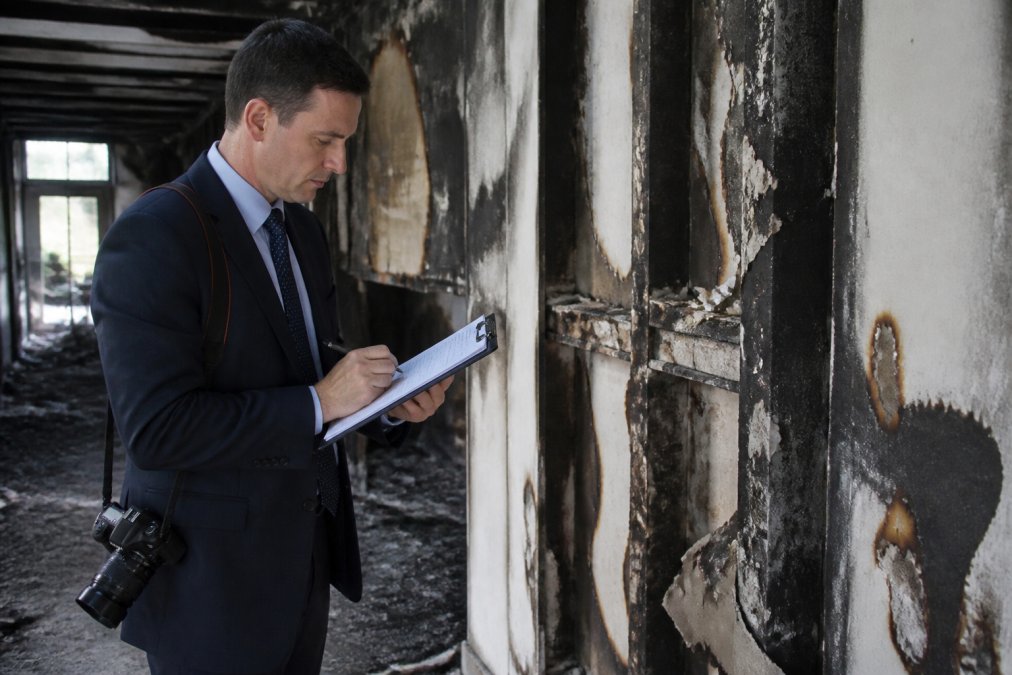
The adjuster’s role is to investigate the claim and determine whether the damage is covered under your policy and what the cost of repairs should be.
Schedule the inspection at a time when you can be present. Bring all your documentation, photographs, and inventory lists. Walk the adjuster through the damage, pointing out specific areas and explaining how the loss occurred. Be factual and detailed, but don’t volunteer information beyond what the adjuster asks.
The adjuster will take their own photographs, measurements, and notes. They may use specialized equipment to detect hidden damage, moisture, or structural issues. They’ll interview you about the loss and may request additional documentation on the spot.
A critical mistake is accepting the adjuster’s initial assessment without question. If you disagree with the estimate, say so clearly. Request an itemized breakdown of all repairs and costs included in their estimate.
Ask the adjuster to explain any exclusions or coverage limitations they cite. Request this explanation in writing. If they deny coverage for a specific item or area, ask why and request documentation of the policy language supporting that denial.
Understanding Your Policy Coverage and Exclusions
Your commercial property insurance policy contains specific coverage limits, deductibles, exclusions, and conditions. Understanding these terms is essential to evaluating whether the insurance company’s settlement offer is fair.
Coverage limits set the maximum amount the insurance company will pay for specific types of damage. If your building has a $500,000 coverage limit and the damage costs $600,000 to repair, the insurance company pays only $500,000. Deductibles reduce the payout by a fixed amount, typically $1,000 to $10,000 per claim.
Policy exclusions are perils or situations the policy does NOT cover. Common exclusions include flood, earthquake, wear and tear, maintenance issues, and intentional damage. Some policies exclude business interruption unless you’ve purchased it as a separate endorsement. Understanding what your policy excludes helps you identify which damages are covered and which aren’t.
Named peril policies cover only the specific perils listed in the policy, typically fire, lightning, wind, hail, and theft. All-risk policies cover any peril except those specifically excluded. All-risk policies provide broader coverage but typically cost more.
Review your policy carefully before the adjuster arrives. Highlight sections that support your claim. Note any exclusions that might apply to your specific loss. If you’re unsure whether a particular type of damage is covered, ask your insurance agent or a public adjuster before the inspection.
The insurance company may cite policy exclusions or coverage limitations to deny or reduce your claim. If you disagree with their interpretation, challenge it.
Commercial Insurance Claim Timeline: What to Expect
Understanding the typical timeline for a commercial property insurance claim helps you plan your recovery and avoid unrealistic expectations. The actual timeline varies based on claim complexity, damage severity, and whether disputes arise.
The initial claim review typically takes 7 to 14 days. During this phase, the insurance company verifies coverage and schedules the adjuster inspection. The adjuster inspection itself usually occurs within 2 to 4 weeks of your loss report, depending on the adjuster’s availability and the complexity of the claim.
After the inspection, the adjuster prepares a damage assessment and repair estimate. This typically takes 2 to 4 weeks. Once the estimate is complete, the insurance company sends you a settlement offer. This is where negotiation often begins.
If you accept the settlement offer, payment typically follows within 2 to 4 weeks. If you dispute the offer or request additional consideration, the timeline extends significantly. Negotiations can take weeks or months, depending on how far apart your position and the insurance company’s position are.
For complex claims involving business interruption, significant structural damage, or multiple areas of the property, the entire process can take 3 to 6 months or longer. If the claim goes to appraisal or litigation, the timeline extends even further, potentially 6 months to several years.
The key is to manage expectations and maintain organized communication throughout. Keep detailed records of all correspondence, inspection dates, and settlement discussions. This documentation becomes crucial if disputes arise.
Business Interruption Insurance Claim Requirements
Business interruption insurance covers lost income when your business operations are interrupted by a covered peril. Filing a business interruption claim requires different documentation than a standard property damage claim.
Business interruption claims require proof of lost income. Gather financial records showing your business’s income before the loss occurred. Provide tax returns, profit and loss statements, bank deposits, and revenue records for the 12 months preceding the loss. This establishes your baseline income.
Calculate the actual income lost during the interruption period.
Step 4: Claim Evaluation and Settlement Negotiation
After the adjuster submits their assessment, the insurance company’s claims department reviews the estimate and prepares a settlement offer.
Common Types of Commercial Property Claims
Different types of commercial property damage present unique documentation and valuation challenges. Understanding the specifics of your claim type helps you anticipate what the insurance company will request.
Dispute Resolution: Handling Claim Denials and Underpayment
When the insurance company denies your claim or offers significantly less than you believe is fair, you have three primary dispute resolution paths: direct negotiation, appraisal, and litigation. Understanding the mechanics, costs, and appropriate triggers for each option helps you make an informed decision about how to proceed.
Step 1: Written Denial Response and Documentation Escalation
Before pursuing formal dispute resolution, request a written explanation of the denial or underpayment. This is critical: verbal explanations are not binding and create no record. Ask the insurance company to cite the specific policy language, exclusion clause, or coverage condition supporting their position. Many claim denials rest on questionable interpretations of ambiguous policy language.
- Cite the specific policy language you believe supports coverage
- Provide additional documentation the adjuster may have overlooked (photographs, contractor estimates, receipts, expert reports)
- Reference industry standards or building codes that support your damage assessment
- Explain any factual errors in the insurance company’s denial letter
- Request a written response explaining why they maintain their position
Step 2: Appraisal, When to Use It and How It Works
Most commercial property policies include an appraisal clause that allows either party to request an independent review of the claim’s dollar value. Appraisal is appropriate when you and the insurance company disagree on repair costs or the extent of damage, but not when the dispute involves coverage (whether the damage is covered at all).
How appraisal works:
- Either party requests appraisal in writing, typically within 60 days of the denial or settlement offer
- You select an appraiser (usually a contractor, engineer, or certified property appraiser); the insurance company selects an appraiser
- The two appraisers inspect the damage and prepare independent estimates
- If the appraisers’ estimates differ by less than a set amount (often 10%), the average becomes binding
- If estimates differ by more than that threshold, the two appraisers select an umpire who reviews both estimates and makes a final determination
- The insurance company pays for the appraisal process; you pay nothing
Step 3: Litigation, When to Pursue It and What to Expect
Litigation is appropriate when the insurance company has denied coverage you believe is clearly covered, when the underpayment is substantial enough to justify legal costs, or when appraisal has failed to resolve a significant valuation dispute.
When litigation is justified: Litigation makes economic sense when:
- The claim value exceeds $100,000
- The insurance company has denied coverage based on questionable policy interpretation
- Appraisal has been exhausted and the remaining dispute is substantial
- You have strong documentation supporting your position
Decision Framework: Which Path to Choose
Claim value under $50,000 + valuation dispute only: Direct negotiation with documentation escalation. If that fails, appraisal. Litigation costs likely exceed potential recovery.
Public Adjuster vs. Company Adjuster: Understanding the Difference
The adjuster assigned to your claim works for the insurance company, not for you. Understanding this fundamental conflict of interest helps you protect your interests throughout the claim process.
Managing Repairs and Restoration After Settlement
Once you’ve reached a settlement agreement with the insurance company, the focus shifts to repairs and restoration. Managing this phase effectively ensures your property is restored properly and you maintain records for any future claims.
Conclusion: Protecting Your Rights Throughout the Claim Process
The commercial property insurance claim process is complex. Understanding each phase of the process and maintaining meticulous documentation gives you the use needed to protect your interests and achieve fair settlements.
| Phase | Timeline | Key Actions |
|---|---|---|
| Loss Reporting | Days 1-7 | Report loss, provide basic information, request claim number |
| Initial Review | Days 7-21 | Gather documentation, organize records, prepare for inspection |
| Adjuster Inspection | Days 21-56 | Conduct inspection, provide documentation, discuss damage assessment |
| Estimate Preparation | Days 56-84 | Review estimate, identify discrepancies, prepare response |
| Settlement Negotiation | Days 84-180+ | Negotiate offer, provide additional documentation, consider appraisal or public adjuster |
| Repairs and Restoration | Ongoing | Obtain contractor estimates, manage repairs, maintain records |
EXTERNAL SOURCES:
Frequently Asked Questions
How long does a commercial insurance claim typically take from start to finish?
The commercial insurance claim timeline varies depending on claim complexity, but most straightforward claims are resolved within 30-60 days. More complex claims involving business interruption or significant property damage may take 90 days or longer. Factors that extend timelines include the need for additional inspections, disputes over coverage, requests for supplemental documentation, and the scope of damage assessment. Staying organized and responsive to your insurer’s requests can help accelerate the process.
What are the most common mistakes businesses make when filing property claims?
Common errors include failing to document damage immediately with photos and video, underestimating the full extent of losses, not reviewing the policy exclusions before filing, missing deadlines for proof of loss submission, and accepting the initial adjuster’s assessment without verification. Many businesses also neglect to keep detailed records of inventory, maintenance receipts, and replacement costs, which are essential for substantiating claims. These mistakes often result in lower settlements or claim denials.
What documentation do I need to support a business interruption insurance claim?
Business interruption insurance claim requirements include proof of the covered peril (fire, water, storm damage), evidence of business closure or operational disruption, financial records showing lost income (tax returns, profit-and-loss statements, payroll records), documentation of the time needed for repairs and restoration, and proof that the property damage directly caused the business interruption. You’ll also need lease agreements, customer contracts, and records of ongoing expenses during the closure period. The more detailed your financial documentation, the stronger your claim.
Can a public adjuster really help if my claim has already been denied?
Yes. A public adjuster can review the denial, identify coverage you may have missed, gather additional evidence, and present a stronger case to the insurance company. Many denials are based on incomplete documentation or misinterpretation of policy language. A public adjuster works exclusively for you (not the insurance company), has expertise in policy language and claim valuation, and can negotiate on your behalf. If the insurer still refuses, you have options like appraisal or legal action, which a public adjuster can help guide you through.
What is the difference between replacement cost and actual cash value in commercial property claims?
Replacement cost is the full expense to repair or replace damaged property at current market prices, while actual cash value subtracts depreciation from that replacement cost. Most commercial policies offer replacement cost coverage, which is more favorable to policyholders. However, some policies or specific items may be limited to actual cash value. Review your policy declarations page to understand which valuation method applies to your coverage. This distinction can significantly impact your settlement amount.
How do I know if my claim is being handled fairly by the insurance company’s adjuster?
Request a detailed written estimate from the adjuster that breaks down all damages, repair costs, and the reasoning behind their valuation. Compare this against independent estimates from contractors or engineers. Review your policy to confirm the adjuster’s assessment aligns with your coverage limits and exclusions. If the adjuster’s estimate seems significantly lower than independent assessments or if they deny coverage you believe should apply, seek a second opinion. Many policyholders benefit from having a public adjuster review the insurer’s work before accepting a settlement.
What happens if the insurance company and I disagree on the claim settlement amount?
Most commercial policies include an appraisal clause that allows either party to request an independent appraisal if there’s a dispute over the claim value. In appraisal, a neutral third-party appraiser reviews the evidence and makes a binding decision on the amount. Before pursuing appraisal, you can attempt negotiation directly with the insurer or request a detailed explanation of their valuation. If appraisal doesn’t resolve the dispute, you may pursue litigation or mediation, depending on your policy terms and state law.