
Denied property damage claims can leave Atlanta business owners feeling overwhelmed and financially vulnerable. Understanding how to effectively collect and organize essential claim documentation is the first step toward regaining control and strengthening your case. By preparing a thorough and well-documented claim file, you set yourself up for a smoother insurance process and increase your chances of achieving fair compensation for your losses.
Table of Contents
- Step 1: Gather Essential Documentation For Your Business Claim
- Step 2: Assess And Record Property Damage Thoroughly
- Step 3: Communicate With Your Insurance Provider Effectively
- Step 4: Engage A Licensed Public Adjuster For Expert Review
- Step 5: Negotiate And Verify Your Claim Settlement Carefully
Quick Summary
| Key Point | Explanation |
|---|---|
| 1. Gather essential documentation | Compile police reports, photos, inventory lists, and receipts to establish the legitimacy of your claim. |
| 2. Thoroughly assess property damage | Document all damage with high-quality photos and videos while measuring dimensions for clarity in your claim. |
| 3. Communicate effectively with insurers | Maintain a log of all communications, respond promptly, and document each interaction to strengthen your claim position. |
| 4. Consider hiring a public adjuster | A licensed public adjuster can help navigate complex claims and ensure you receive fair compensation based on expert evaluation. |
| 5. Negotiate your settlement strategically | Research similar claim outcomes and prepare ample documentation to effectively counter low offers from your insurance company. |
Step 1: Gather essential documentation for your business claim
Successfully recovering your full business insurance claim starts with meticulous documentation preparation. Your goal in this critical first step is to compile a comprehensive evidence package that validates your property damage and financial losses.
The documentation process involves systematically collecting multiple types of records. Insurance experts recommend gathering the following key materials:
- Police or incident reports detailing the original event
- Photographic evidence showing damage from multiple angles
- Detailed inventory lists of destroyed or damaged property
- Financial records demonstrating business interruption losses
- Repair estimates from licensed contractors
- Original purchase receipts for damaged equipment
When collecting these documents, be sure to create systematic documentation records that are organized, dated, and easily accessible. Each piece of documentation serves as critical proof supporting your insurance claim’s legitimacy.
Digital storage is crucial – scan all physical documents and maintain both digital and physical copies. Organize your files chronologically and create backup copies in multiple secure locations. This systematic approach demonstrates professionalism and helps prevent potential claim complications.
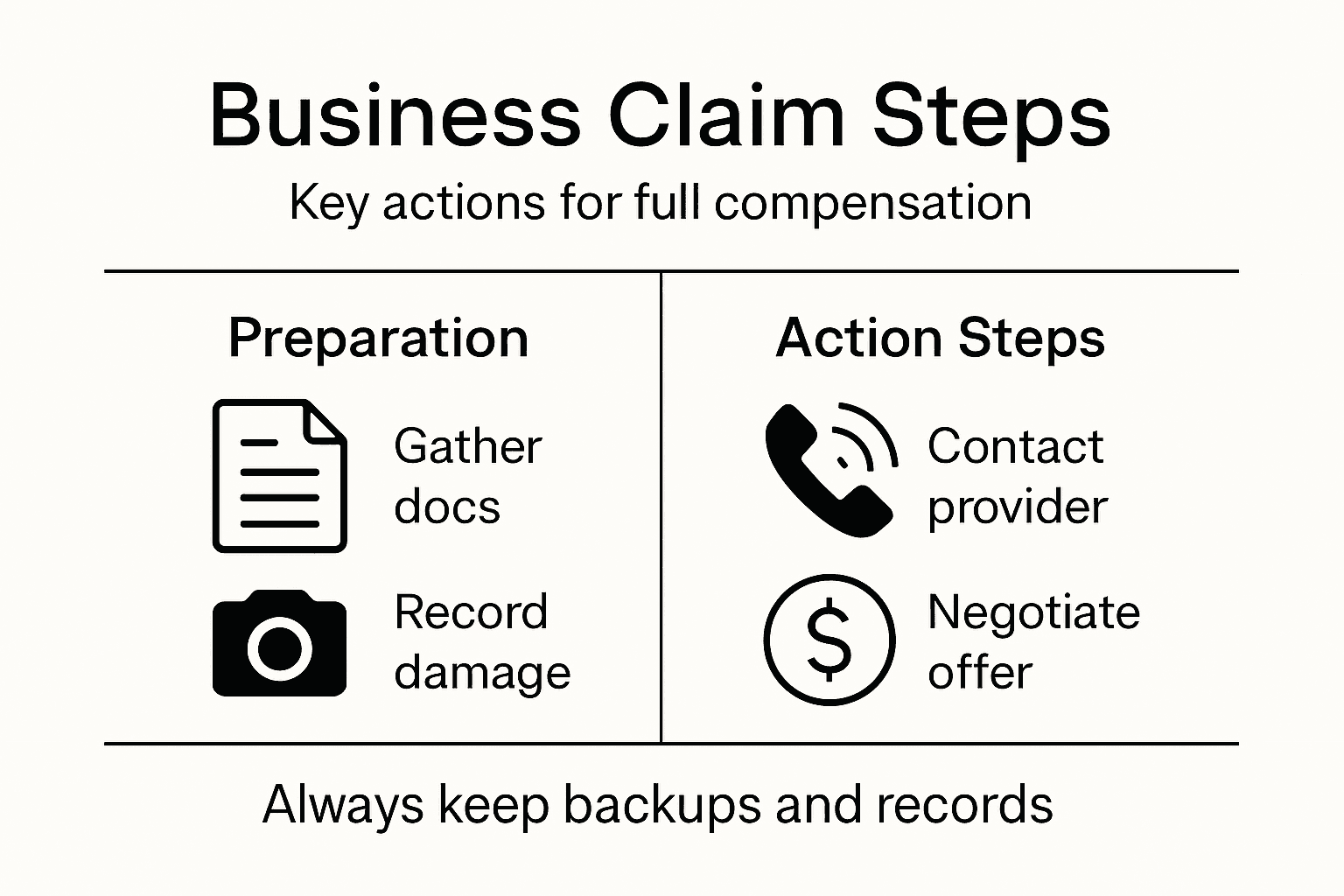
Here’s a summary of digital documentation strategies and their advantages for business insurance claims:
| Digital Strategy | How It Works | Benefits for Claims |
|---|---|---|
| Scanning documents | Create readable digital files | Preserves original evidence |
| Chronological folders | Organize files by event date | Speeds up retrieval for review |
| Cloud backups | Secure online file storage | Protects against data loss |
| Dual format storage | Keep both digital & physical | Reduces risk of missing records |
Thorough documentation is your strongest weapon in securing full compensation for business property damage.
Pro tip: Create a dedicated claim folder with clearly labeled sections to streamline your documentation management process and make information retrieval effortless during negotiations.
Step 2: Assess and record property damage thoroughly
Thoroughly documenting property damage is a critical step in ensuring your business insurance claim receives full compensation. Your objective is to create a comprehensive visual and written record that provides irrefutable evidence of the extent of your losses.
To effectively assess and document property damage, follow these systematic steps:
- Photograph everything with high-resolution digital images
- Video record the entire damaged area from multiple angles
- Measure and document specific dimensions of damaged structures
- Mark and tag individual damaged items for inventory
- Preserve damaged items as potential evidence
- Collect professional repair estimates
When conducting your assessment, document damage with precise records that capture the full scope of your property losses. Professional documentation helps insurance adjusters understand the complete picture of your claim.
Pay special attention to capturing detailed information about structural damage, equipment impairment, and inventory losses. Take close-up shots that reveal specific damage details, and wide-angle images that demonstrate overall destruction. Timestamp all photographs and videos to establish a clear chronology of the damage.
Comprehensive damage documentation is your strongest defense in securing fair insurance compensation.
Pro tip: Create a digital backup of all damage documentation in multiple secure locations, including cloud storage and external hard drives, to prevent potential loss of critical evidence.

Step 3: Communicate with your insurance provider effectively
Effective communication with your insurance provider is a critical strategic process that can significantly impact the success of your business insurance claim. Your primary goal is to establish clear, professional, and well-documented interactions that protect your interests and expedite claim resolution.
To communicate professionally and effectively, implement these key strategies:
- Document every interaction in writing
- Create a communication log with dates and details
- Respond promptly to all insurance requests
- Be concise and factual in all communications
- Request written confirmations of verbal agreements
- Maintain a professional tone throughout the process
Maintain clear communication records that demonstrate your commitment to transparency and cooperation. Insurance companies appreciate thorough and organized claimants who can provide precise information quickly and professionally.
When communicating with your insurance provider, focus on providing specific details about your claim. Use clear, objective language and avoid emotional statements. Include reference numbers on all correspondence, keep copies of everything, and consider using certified mail or email with read receipts to track your communications.
Professional and systematic communication is your most powerful tool in navigating the insurance claim process.
Pro tip: Create a dedicated email folder and physical file for all insurance claim communications to ensure you can quickly retrieve and reference any document or correspondence.
Step 4: Engage a licensed public adjuster for expert review
Navigating a complex business insurance claim requires specialized expertise that goes beyond your internal capabilities. A licensed public adjuster serves as your professional advocate, ensuring you receive maximum compensation for your property damage.
When selecting a public adjuster, consider these critical evaluation criteria:
- Verify state licensing credentials
- Check professional references and past claim successes
- Understand their fee structure upfront
- Request detailed experience in your specific industry
- Confirm professional liability insurance
- Evaluate communication skills during initial consultation
Understand the role of licensed adjusters who work exclusively to protect your financial interests. These professionals have deep expertise in decoding complex insurance policies and negotiating settlements that insurance companies might initially resist.
A skilled public adjuster brings substantial value by conducting independent damage assessments, preparing comprehensive claim documentation, and leveraging industry knowledge to counter potential undervaluation tactics. They transform the claims process from a potentially adversarial interaction into a strategic negotiation focused on securing your full entitled compensation.
Compare your direct negotiation approach with enlisting a licensed public adjuster:
| Approach | Key Strength | Potential Drawback | Typical Outcome |
|---|---|---|---|
| Self-Negotiation | Direct cost savings | Limited insurance expertise | Slower, smaller settlements |
| Public Adjuster | Specialized knowledge | Adjuster fees incurred | Faster, higher compensation |
A knowledgeable public adjuster can be the difference between a minimal settlement and full financial recovery.
Pro tip: Request a free initial consultation with potential public adjusters to assess their expertise and compatibility with your specific claim before making a final commitment.
Step 5: Negotiate and verify your claim settlement carefully
Successfully negotiating your business insurance claim requires strategic preparation and a detailed understanding of your claim’s true value. Your objective is to secure a settlement that fully compensates you for all documented property damages and business interruptions.
When entering settlement negotiations, follow these critical strategies:
- Research comparable claim settlements in your industry
- Prepare comprehensive documentation of all losses
- Calculate exact financial impact of property damage
- Know your policy’s coverage limits
- Remain professional and objective
- Be prepared to counter lowball offers
Negotiate insurance settlements strategically by understanding that initial offers are typically designed to minimize your compensation. Insurance companies expect negotiation, so approach the process with confidence and well-documented evidence.
During negotiations, maintain a calm and professional demeanor. Systematically review each aspect of the proposed settlement, comparing it against your documented losses. Request detailed explanations for any discrepancies and be prepared to provide additional evidence that supports your claim’s full value.
Your thorough preparation and strategic approach are your most powerful tools in securing fair compensation.
Pro tip: Create a side-by-side comparison spreadsheet that details the insurance company’s initial offer versus your documented losses to clearly visualize negotiation points.
Maximize Your Business Insurance Claim with Trusted Public Adjusters in Atlanta
Navigating the intricate steps outlined in the “Business Insurance Claim Guide for Full Compensation” can feel overwhelming. From assembling thorough documentation to negotiating fair settlements, business owners face critical challenges such as providing detailed damage assessments and maintaining professional communication. If you are seeking expert support to handle these complex pain points and want to ensure every aspect of your claim is managed effectively, partnering with a licensed public adjuster is essential.
At Public Adjusters Atlanta, we specialize in advocating for businesses just like yours throughout the Atlanta, Georgia area. Our experienced team offers comprehensive claim review and policy evaluation to uncover every opportunity for full compensation. With professional damage assessments and skilled negotiation on your side, you can confidently navigate the settlement process knowing your interests are prioritized. Act now to transform your insurance claim experience and maximize your recovery by contacting our trusted public adjusters for a free consultation today.
Frequently Asked Questions
What documentation do I need to prepare for my business insurance claim?
To prepare your business insurance claim, gather essential documentation including police reports, photographic evidence of damage, detailed inventory lists, financial records showing losses, repair estimates, and original purchase receipts. Create a well-organized folder with all these documents to ensure they are easily accessible when needed.
How can I assess property damage effectively for my claim?
Assess property damage by photographing everything with high-resolution images, recording video of the damaged area, and documenting specific dimensions. Make sure to preserve any damaged items as potential evidence to strengthen your claim.
How should I communicate with my insurance provider during the claims process?
Communicate with your insurance provider by documenting every interaction in writing and maintaining a communication log detailing dates and discussions. Respond promptly to requests, use clear and factual language, and request written confirmations of any verbal agreements made.
Why should I consider hiring a licensed public adjuster for my claim?
Hiring a licensed public adjuster can provide specialized knowledge and advocacy for your claim, ensuring you receive maximum compensation for property damage. They can conduct independent damage assessments and negotiate on your behalf, often leading to higher settlements.
What strategies can I use to negotiate my business insurance claim settlement?
To negotiate your claim settlement effectively, prepare comprehensive documentation of your losses and research comparable claim settlements in your industry. Approach negotiations calmly and professionally, being ready to counter low offers with well-documented evidence supporting the full value of your claim.
How can I keep my documentation organized when filing a business insurance claim?
Keep your documentation organized by creating a dedicated claim folder with clearly labeled sections for different types of evidence, such as photographs, inventory lists, and financial records. Use both digital and physical formats, and consider a chronological approach to streamline information retrieval when needed.