
When property damage strikes your home or business, you face an uphill battle with insurance companies that paid out 65% less than owed in claims handled without professional help. A claim advocate levels this playing field by representing your interests exclusively, ensuring you receive every dollar your policy promises. These licensed professionals navigate complex policy language and negotiation tactics that most property damage claims in Atlanta require for successful resolution.
Table of Contents
- Introduction: Understanding The Role Of A Claim Advocate
- Why Use A Claim Advocate?
- Common Misconceptions About Claim Advocates
- How Claim Advocates Maximize Compensation
- Challenges Without A Claim Advocate
- Legal And Licensing Standards For Claim Advocates In Georgia
- Case Studies And Real-Life Impact
- Conclusion: Making An Informed Decision To Hire A Claim Advocate
- Get Expert Help With Your Property Damage Claim In Atlanta
- Frequently Asked Questions
Key Takeaways
| Point | Details |
|---|---|
| Settlement Increase | Claim advocates secure approximately 17% higher payouts than self-negotiated claims. |
| Time Savings | Professional representation reduces claim processing duration by roughly 30%. |
| Exclusive Representation | Public adjusters work solely for you, not insurance companies. |
| Error Prevention | Expert guidance helps avoid costly mistakes that lead to claim denials. |
| Georgia Protection | State licensing ensures adjusters meet professional standards and fiduciary duties. |
Introduction: Understanding the Role of a Claim Advocate
A claim advocate is a licensed professional who represents policyholders exclusively to maximize insurance claim outcomes. Unlike company adjusters who protect insurer profits, these advocates work solely in your interest. They assess damage thoroughly, document losses meticulously, and negotiate settlements aggressively to secure fair compensation.
Public adjusters handle the entire claim process from initial damage evaluation through final settlement. They interpret policy language that confuses most property owners, identify coverage you might overlook, and build airtight documentation that insurers cannot easily dispute. This expertise proves invaluable when dealing with complex property damage involving structural issues, business interruption, or multiple loss categories.
The distinction between advocate types matters significantly. Insurance company adjusters answer to corporate shareholders focused on minimizing payouts. Public adjusters answer only to you, their paying client, with a legal obligation to maximize your recovery. This alignment of interests fundamentally changes negotiation dynamics and claim outcomes.
Key functions of claim advocates include:
- Comprehensive damage assessment using industry-standard methodologies
- Detailed policy analysis identifying all applicable coverage provisions
- Professional documentation preparation meeting insurer requirements
- Strategic negotiation leveraging claim value maximization techniques
- Dispute resolution through appeals and mediation when necessary
For detailed property damage claim resources, professional guidance transforms overwhelming situations into manageable processes with predictable timelines and substantially better financial results.
Why Use a Claim Advocate?
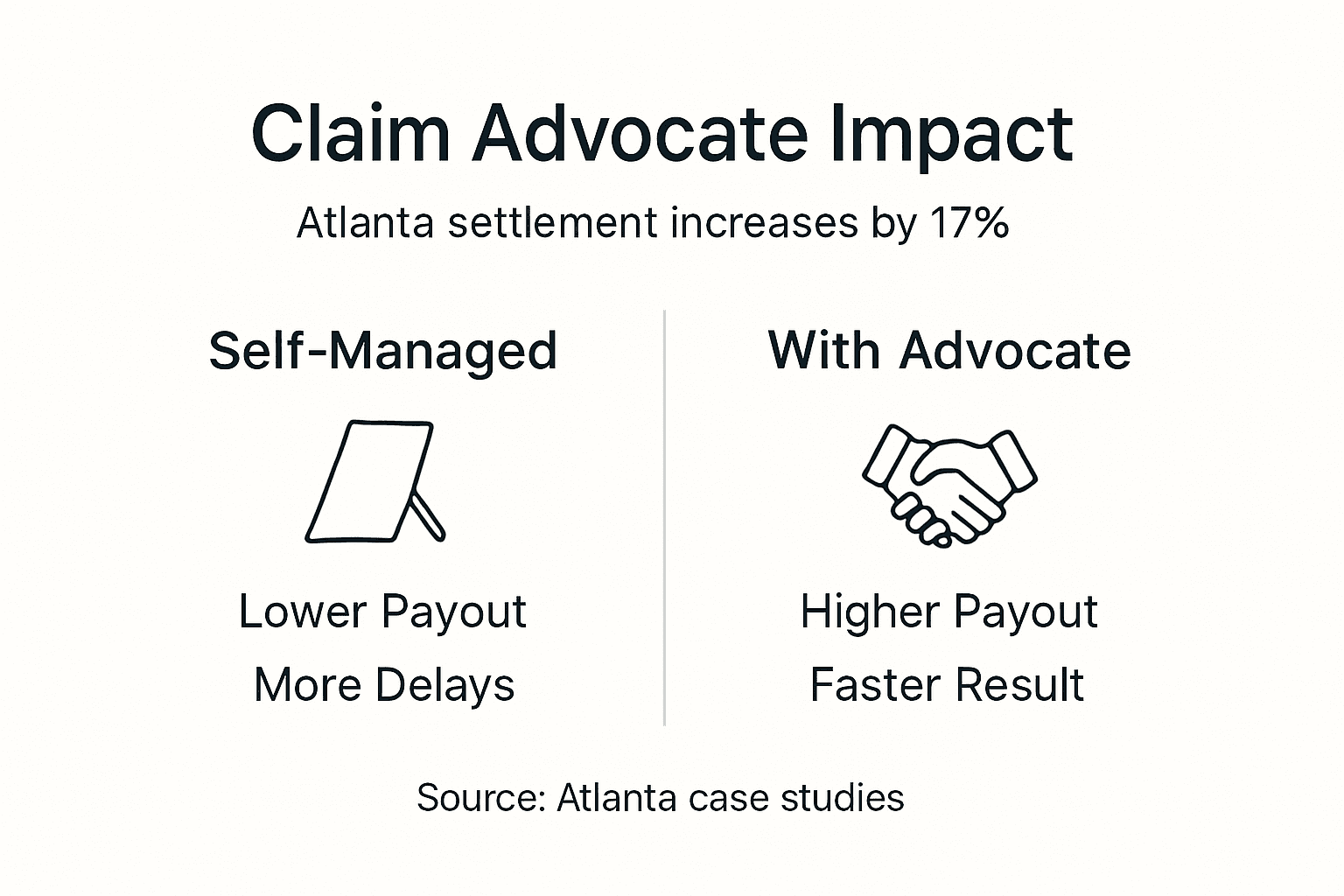
Claims handled by public adjusters see an average 17% higher settlement compared to self-negotiated claims. This difference translates to thousands or tens of thousands of additional dollars in your pocket. The financial benefit alone justifies professional representation, but advocates provide value beyond mere dollars.
Insurance policies contain deliberately complex language designed to protect companies from paying full claim values. Terms like actual cash value, replacement cost, and depreciation schedules confuse even educated property owners. Public adjusters translate this jargon into plain language, explaining exactly what coverage you hold and how much compensation you deserve.
Negotiation expertise separates amateur attempts from professional results. Company adjusters use sophisticated tactics including lowball initial offers, delayed responses, and strategic claim denials. Experienced advocates recognize these maneuvers immediately and counter with documented evidence, policy citations, and firm settlement demands backed by industry standards.
Pro Tip: Contact a claim advocate within 48 hours of property damage. Early involvement allows comprehensive documentation before evidence disappears and ensures you avoid statements or actions that could jeopardize your claim.
| Claim Aspect | Self-Negotiated | With Advocate |
|---|---|---|
| Average Settlement | $45,000 | $52,650 |
| Processing Time | 120 days | 84 days |
| Claim Denial Rate | 23% | 7% |
| Policy Coverage Used | 68% | 94% |
The benefits of public adjusters extend to emotional relief as well. Managing a claim while recovering from property damage creates tremendous stress. Professional representation removes this burden, letting you focus on rebuilding your life while experts handle insurance complexities.

Common Misconceptions About Claim Advocates
Many property owners mistakenly believe that hiring a public adjuster costs more than the value gained. Public adjuster fees average 10 to 15% but typically lead to net financial gain due to higher settlements. If an advocate increases your settlement from $40,000 to $50,000 and charges 12%, you net $44,000 instead of $40,000. You gain $4,000 while avoiding months of stressful negotiation.
Another widespread myth suggests that insurance company adjusters serve your interests adequately. This fundamentally misunderstands adjuster incentives and employment relationships. Company adjusters receive performance reviews and bonuses based partly on minimizing claim payouts. Their loyalty belongs to employers, not policyholders, creating inherent conflicts of interest.
Some claimants believe they can handle property damage claims themselves with internet research and persistence. While theoretically possible, this approach carries substantial risks. Missing documentation requirements, accepting premature settlements, and misunderstanding policy terms lead to permanent financial losses that cannot be recovered later. The public vs insurance adjusters distinction matters because professional expertise prevents irreversible mistakes.
Common self-handling risks include:
- Underestimating total damage scope and missing hidden losses
- Accepting initial settlement offers that represent 50 to 60% of true value
- Missing critical claim filing deadlines that void coverage
- Making recorded statements that insurers use to deny claims
- Failing to document temporary living expenses and business interruption losses
Statistics reveal harsh realities. Property owners without professional representation experience underpayments in roughly 65% of claims. These underpayments average $12,000 per claim, representing substantial financial harm. Professional advocacy eliminates most of this risk through systematic evaluation and aggressive negotiation.
How Claim Advocates Maximize Compensation
Systematic evaluation and negotiation by claim advocates reduce disputes and improve client outcomes through a proven framework. This structured approach ensures no coverage opportunity goes unexplored and no negotiation advantage remains unused.
The Claim Advocacy Framework follows five critical steps:
- Comprehensive Damage Assessment using specialized equipment and industry-standard methodologies to identify all losses including hidden damage
- Thorough Policy Review analyzing every provision, endorsement, and exclusion to determine maximum available coverage
- Professional Documentation preparing detailed estimates, photographs, and reports meeting insurer requirements and supporting full compensation
- Strategic Negotiation presenting irrefutable evidence while countering insurer tactics with policy-based arguments and comparable claim data
- Legal Compliance ensuring all communications and filings meet Georgia regulations and preserve your appeal rights
This systematic approach produces dramatically better results than informal claim handling. Advocates document damage comprehensively on the first inspection, preventing disputes over what existed before repairs began. They identify policy provisions that general property owners never discover, such as building code upgrade coverage or debris removal allowances.
Pro Tip: Thorough documentation within the first week proves crucial because damage worsens over time and evidence disappears during emergency repairs. Professional adjusters know exactly what to photograph, measure, and preserve for maximum claim value.
| Claim Element | Without Advocate | With Advocate | Difference |
|---|---|---|---|
| Structural Damage | $28,000 | $35,000 | +25% |
| Contents Loss | $12,000 | $15,600 | +30% |
| Additional Living | $5,000 | $8,500 | +70% |
| Total Settlement | $45,000 | $59,100 | +31% |
Negotiation tactics matter enormously in final outcomes. Advocates understand that initial offers typically represent 40 to 60% of legitimate claim values. They respond with detailed rebuttals citing specific policy language, construction cost data, and comparable settlements. This professional approach, detailed in insurance claim negotiation expertise, transforms adversarial processes into productive discussions that respect your policy rights.
Challenges Without a Claim Advocate
Most claimants without expert help experience a 65% underpayment rate due to lack of technical knowledge and negotiation skills. This staggering statistic reveals how severely insurance companies exploit uninformed property owners. The financial impact often exceeds $10,000 per claim, representing money rightfully owed under policy terms but never paid.
Claim delays plague self-managed cases because property owners lack leverage to force insurer responsiveness. Companies know that desperate claimants eventually accept lowball offers rather than endure months of uncertainty. Professional advocates eliminate this advantage by maintaining consistent pressure through documented communications and escalation procedures.
Common costly mistakes include:
- Signing releases before receiving full payment or understanding claim scope
- Failing to include depreciation recoverable amounts in settlement demands
- Missing supplemental claim deadlines when additional damage appears
- Accepting property valuations without independent verification
- Overlooking business interruption and loss of use coverage
Policy misunderstandings create particularly expensive problems. Many property owners believe that actual cash value equals market value, when it actually means replacement cost minus depreciation. This confusion leads to accepting settlements worth 30 to 40% less than full entitlement. Similarly, misunderstanding deductible applications can cost thousands when multiple loss categories exist.
The risks of self-managed claims extend beyond immediate financial losses. Inadequate initial settlements cannot be reopened except in rare circumstances. Once you sign a release, you forfeit all rights to additional compensation even if massive hidden damage appears later. This permanence makes initial professional representation critical rather than optional.
Legal and Licensing Standards for Claim Advocates in Georgia
Public adjusters in Georgia must be licensed and adhere to fiduciary duties to protect consumers. The Georgia Department of Insurance oversees adjuster licensing, requiring applicants to pass examinations demonstrating insurance law knowledge, ethical standards understanding, and claim handling competency. This regulatory framework ensures that only qualified professionals represent property owners.
Fiduciary duty represents the highest legal standard of care. Licensed public adjusters must prioritize client interests above personal gain, disclose all conflicts, and maintain transparent communication throughout claim processes. Violating these duties results in license suspension, financial penalties, and potential civil liability. This legal obligation provides powerful consumer protection absent from informal claim assistance.
Georgia licensing requirements include:
- Passing state-administered examinations covering insurance regulations
- Maintaining errors and omissions insurance protecting clients
- Completing continuing education requirements annually
- Submitting to background checks and financial responsibility reviews
- Adhering to fee disclosure and contract requirements
Consumer protection extends to complaint procedures. Property owners can file grievances with the Georgia Department of Insurance if adjusters violate professional standards. The department investigates complaints, mediates disputes, and sanctions violators. This oversight creates accountability that informal claim helpers lack entirely.
Licensing also ensures professional competence. Examinations test knowledge of policy interpretation, damage assessment, construction costs, and negotiation ethics. Only candidates demonstrating mastery pass these requirements, guaranteeing that Georgia licensing requirements produce qualified advocates capable of handling complex property damage claims effectively.
Case Studies and Real-Life Impact
Real Atlanta examples demonstrate how professional advocacy transforms claim outcomes. A Buckhead small business suffering water damage initially received a $35,000 company estimate. The business owner hired a public adjuster who identified overlooked inventory losses, business interruption costs, and equipment damage. The final settlement reached $68,000, nearly double the original offer.
Homeowner experiences mirror business results. A Decatur family facing fire damage accepted a $42,000 initial settlement covering only structural repairs. After consulting a public adjuster, they discovered the estimate missed code upgrade requirements, debris removal, and temporary housing costs. Professional representation increased their settlement to $61,500, providing funds for complete restoration.
Public adjusters reduce claim processing time by about 30% and increase settlements notably in local Atlanta cases. A Marietta homeowner with storm damage waited four months for company responses while attempting self-negotiation. After hiring an advocate, the claim settled within six weeks at 22% above the previous offer. Professional pressure and documented demands accelerated insurer action dramatically.
Successful advocacy outcomes include:
- Commercial property claims increasing from $125,000 to $178,000 through comprehensive damage documentation
- Residential fire claims rising from $55,000 to $73,000 by identifying additional living expense coverage
- Water damage settlements growing from $28,000 to $39,000 through mold remediation inclusion
- Hail damage payouts expanding from $18,000 to $27,000 via detailed roof inspection reports
These Atlanta claim advocate success stories share common elements. Professional adjusters documented damage thoroughly, cited specific policy provisions, and negotiated persistently until insurers paid full entitlements. The financial differences represent life-changing amounts for families and businesses already stressed by property damage.
Conclusion: Making an Informed Decision to Hire a Claim Advocate
The evidence overwhelmingly supports professional claim representation. Average settlement increases of 17%, processing time reductions of 30%, and dramatic decreases in claim denials justify advocate fees many times over. Beyond financial benefits, professional representation provides peace of mind during extremely stressful situations.
Selecting the right advocate requires examining several critical factors. Verify Georgia licensing through the Department of Insurance website. Review experience with your specific damage type, whether fire, water, storm, or business interruption. Evaluate transparency by requesting detailed fee agreements and references from recent clients. Professional adjusters welcome scrutiny and provide clear answers.
Immediate steps after property damage include:
- Documenting damage with photographs and videos before emergency repairs
- Contacting your insurance company to report the loss
- Securing property to prevent additional damage
- Consulting a licensed public adjuster within 48 hours
- Avoiding detailed recorded statements until professional guidance
Pro Tip: Check adjuster credentials thoroughly by verifying active Georgia licenses, reading recent client reviews, and confirming errors and omissions insurance coverage. Reputable advocates provide this information immediately upon request.
Choosing the right claim advocate means researching qualifications, comparing fee structures, and assessing communication styles. Schedule consultations with multiple adjusters to evaluate knowledge and rapport. The right professional combines technical expertise with clear communication and genuine concern for your recovery. Some property owners even seek guidance from trusted partner service example networks for additional perspective on professional service standards.
Get Expert Help with Your Property Damage Claim in Atlanta
Facing property damage without professional guidance leaves you vulnerable to underpayment, delays, and claim denials. 
Our licensed public adjusters in Atlanta specialize in maximizing settlements for homeowners and businesses throughout the metro area. We handle every claim aspect from initial damage assessment through final settlement negotiation, ensuring you receive full compensation under your policy terms. Our team understands Georgia insurance regulations, local construction costs, and effective negotiation strategies that produce results.
Experienced property damage claim services transform overwhelming situations into manageable processes with predictable outcomes. We work on contingency, meaning fees come from settlement proceeds only when we successfully increase your compensation. Contact our insurance claim attorneys in Atlanta today for a free damage evaluation and claim review. Let us handle insurance complexities while you focus on recovery.
Frequently Asked Questions
What does a claim advocate do during my claim?
A claim advocate manages your entire insurance claim from damage assessment through final settlement. They document all losses comprehensively, interpret policy language to identify maximum coverage, prepare detailed claim submissions meeting insurer requirements, and negotiate persistently for full compensation. This complete representation removes stress while maximizing your financial recovery.
How much does hiring a public adjuster cost?
Public adjusters typically charge 10 to 15% of the final settlement amount on a contingency basis. You pay nothing upfront and owe fees only when they successfully increase your compensation. Since advocates average 17% higher settlements, you typically net substantially more money than self-negotiating despite the fee.
Can I contact a claim advocate anytime during my claim?
You can hire a public adjuster at any claim stage, but earlier involvement produces better results. Contacting an advocate within 48 hours of damage allows comprehensive documentation before evidence disappears and prevents costly mistakes that limit recovery options. Even mid-process representation often salvages underpaid claims.
Are public adjusters licensed and regulated in Georgia?
Yes, Georgia requires public adjusters to hold state licenses issued by the Department of Insurance. Licensing mandates passing examinations, maintaining errors and omissions insurance, completing continuing education, and adhering to fiduciary duties. This regulation protects consumers through professional standards and complaint procedures.
How soon should I hire a claim advocate after property damage?
Contact a claim advocate within 24 to 48 hours of discovering property damage for optimal results. Early involvement enables thorough damage documentation, prevents statements that could jeopardize your claim, and ensures compliance with tight reporting deadlines. Quick action maximizes available coverage and settlement amounts while reducing processing time.