

When property damage disrupts your Atlanta home or business, the last thing you need is confusion about your insurance claim. Facing complex policies and negotiations can leave policyholders feeling overwhelmed, especially when so much rides on a fair settlement. Understanding the distinct roles of insurance adjusters and the unique advantages offered by a public adjuster could make all the difference in securing the compensation you truly deserve.
Table of Contents
- Defining Adjusters And Public Adjusters
- Types Of Adjusters And Who They Represent
- Roles, Responsibilities, And Legal Requirements
- Compensation And Settlement Impact
- When To Hire A Public Adjuster
Key Takeaways
| Point | Details |
|---|---|
| Understanding Adjusters | There are three types of adjusters: company, independent, and public, each representing different stakeholders and interests. |
| Role of Public Adjusters | Public adjusters advocate exclusively for policyholders, helping maximize claim settlements and navigate complex processes. |
| When to Hire | Consider hiring a public adjuster for significant property damage or complex insurance claims to enhance recovery potential. |
| Verification is Crucial | Always verify an adjuster’s licensing and credentials before engagement to ensure proper representation. |
Defining Adjusters and Public Adjusters
Insurance claims involve complex negotiations, and the professionals handling these processes play critical roles in determining settlement outcomes. An insurance adjuster is a professional who investigates property damage claims, assesses losses, and determines the appropriate compensation amount. These professionals can be categorized into three primary types: company (staff) adjusters, independent adjusters, and public adjusters.
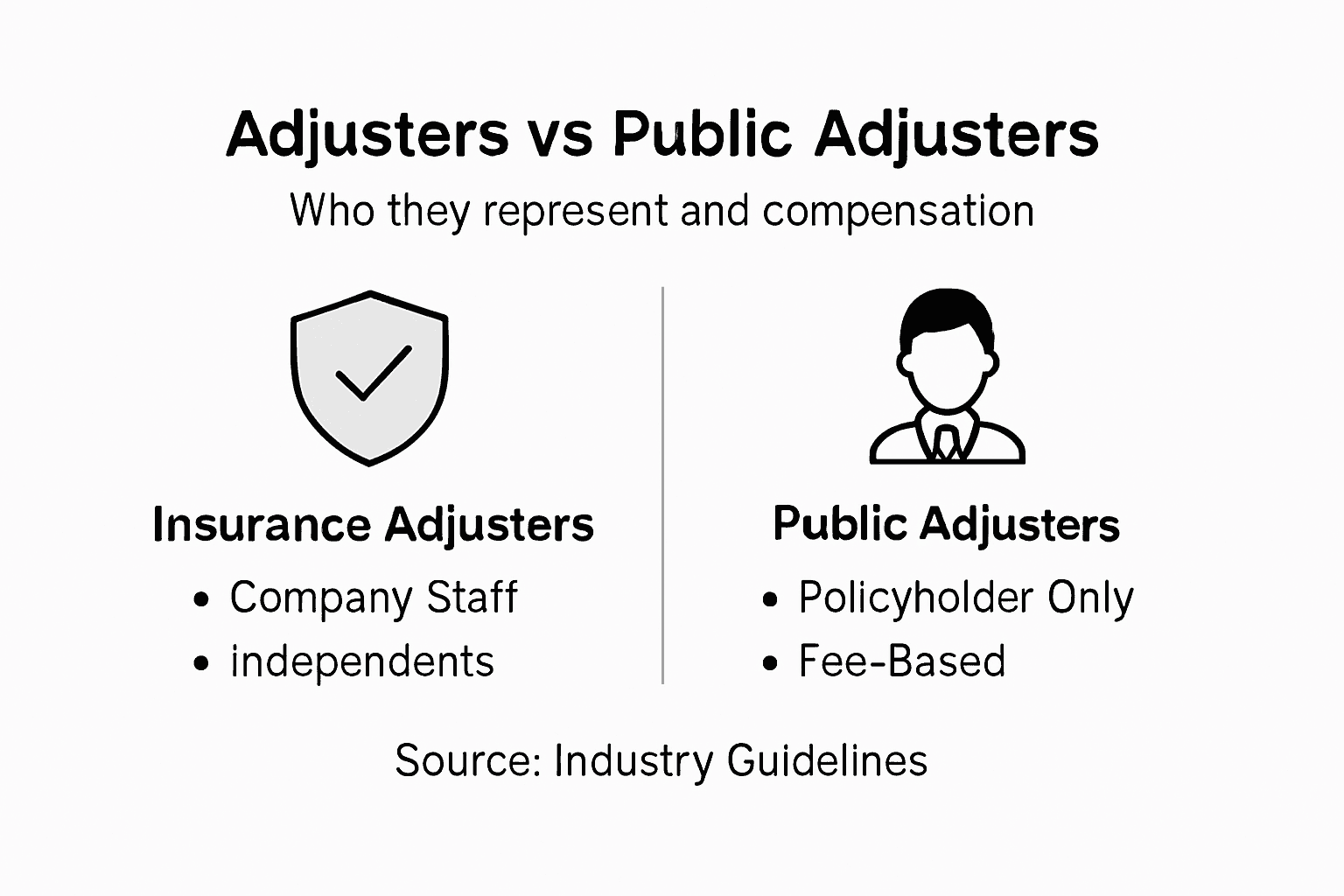
Company adjusters work directly for insurance providers and represent the insurer’s interests during claim investigations. Insurance company adjusters investigate claims to evaluate damage, review policy coverage, and determine settlement amounts that align with the insurance contract. Their primary responsibility is protecting their employer’s financial interests while ensuring fair claim processing.
In contrast, public adjusters operate differently. Public adjusters work exclusively for policyholders and are hired directly by individuals experiencing property damage. These licensed professionals advocate for the insured’s interests, helping homeowners and business owners navigate complex insurance claim processes. Their key responsibilities include:
- Thoroughly documenting property damage
- Preparing detailed claim documentation
- Negotiating with insurance companies
- Maximizing potential claim settlements
- Interpreting complex insurance policy language
Public adjusters typically charge a percentage of the final settlement, usually up to 15%, which incentivizes them to secure the most comprehensive compensation possible. Unlike company adjusters, they have no inherent loyalty to the insurance provider and focus entirely on representing the policyholder’s best interests.
Pro tip: Always verify a public adjuster’s state licensing status and professional credentials before engaging their services to ensure legitimate representation.
Types of Adjusters and Who They Represent
In the complex world of insurance claims, different types of adjusters play unique roles with distinct responsibilities. Three primary types of insurance adjusters exist, each representing different stakeholders in the claims process: company adjusters, independent adjusters, and public adjusters.

Company or staff adjusters are direct employees of insurance providers, working exclusively to protect the insurer’s financial interests. These professionals investigate claims, assess damages, and determine settlement amounts that align with the insurance company’s policies and financial considerations. They receive a regular salary and have a direct employment relationship with the insurance carrier.
Independent adjusters operate differently from staff adjusters. They work as contractors hired by insurance companies to investigate claims, typically during high-volume periods or in geographic areas where the insurance provider lacks local representation. Key characteristics of independent adjusters include:
- Work on a contract basis
- Not permanent employees of any single insurance company
- Paid per claim or project
- Provide flexibility for insurance providers
- Represent the insurance company’s interests
Public adjusters stand apart from other adjuster types. Public adjusters exclusively represent policyholders and are hired directly by individuals experiencing property damage. Unlike company and independent adjusters, they focus entirely on maximizing the policyholder’s claim settlement. These licensed professionals typically charge a percentage of the final settlement, usually between 10-15%, which motivates them to secure the most comprehensive compensation possible.
Here’s a comparison of the three main types of insurance adjusters:
| Adjuster Type | Who They Represent | Compensation Structure | Typical Scenarios |
|---|---|---|---|
| Company/Staff | Insurance company | Salary or hourly wage | Routine claims, large firms |
| Independent | Insurance company (varied) | Per claim or project fee | Catastrophes, busy seasons |
| Public | Policyholder only | Percentage of settlement | High-value, complex claims |
Pro tip: Always request and verify the specific licensing credentials of any adjuster you plan to work with to ensure legitimate and professional representation.
Roles, Responsibilities, and Legal Requirements
Insurance claim resolution involves complex professional responsibilities that are carefully regulated to protect both policyholders and insurance providers. Public insurance adjusters must meet specific legal standards when representing clients in property damage claims, ensuring ethical and professional representation throughout the claims process.
The primary responsibilities of public adjusters encompass a comprehensive range of professional duties. These licensed professionals are tasked with thoroughly evaluating property damage, interpreting complex insurance policies, and preparing detailed claim documentation. Their core responsibilities include:
- Conducting comprehensive property damage assessments
- Interpreting intricate insurance policy language
- Preparing meticulous claim documentation
- Negotiating settlements with insurance companies
- Protecting the policyholder’s financial interests
Legal requirements for public adjusters are stringent and designed to maintain professional standards. The Public Adjuster Licensing Model Act establishes strict guidelines governing their professional conduct. These regulations mandate specific educational requirements, examination standards, and ongoing professional development to ensure adjusters maintain high levels of expertise and ethical practice.
State-level regulations further define the scope of a public adjuster’s work, typically restricting their activities to first-party property damage claims. Public adjusters must operate under a written contract with clear terms, maintain transparency in their fee structures, and adhere to strict disclosure requirements. They are legally obligated to act in good faith, representing only the insured’s interests while maintaining professional integrity throughout the claims process.
Pro tip: Always request a detailed written contract from a public adjuster, clearly outlining their fees, services, and specific responsibilities before engaging their services.
Compensation and Settlement Impact
Understanding the financial dynamics of insurance claims requires a deep dive into how different adjusters impact settlement outcomes. Public adjusters charge percentage-based fees that fundamentally align their interests with the policyholder’s goal of maximizing claim recovery.
Typically, public adjusters negotiate fees ranging between 10% and 20% of the total claim settlement. This compensation structure creates a powerful incentive for these professionals to secure the most comprehensive settlement possible. The fee arrangement means public adjusters are financially motivated to:
- Thoroughly document all property damages
- Identify hidden or overlooked damage elements
- Challenge initial insurance company assessments
- Maximize potential claim value
- Ensure comprehensive claim documentation
Settlement differences can be substantial when comparing claims handled by public adjusters versus standard insurance company adjusters. While company adjusters aim to process claims efficiently, public adjusters specialize in extracting maximum value for policyholders. Regulated by state laws, these professionals cannot exceed policy limits but can significantly improve settlement outcomes through detailed negotiation and expert claim presentation.
The financial impact extends beyond immediate settlement values. Public adjusters bring specialized expertise that can uncover additional damages or coverage aspects often missed by standard insurance assessments. Their comprehensive approach typically results in more thorough claim evaluations, potentially recovering substantially more compensation than policyholders might achieve independently.
Pro tip: Request a detailed fee structure and potential settlement improvement estimate from a public adjuster before signing any contract, ensuring complete transparency about potential costs and benefits.
When to Hire a Public Adjuster
Complex insurance claims require specialized expertise that goes beyond standard insurance company representations. Understanding the right moment to engage a public adjuster can significantly impact your claim’s outcome and potential compensation.
Policyholders should consider hiring a public adjuster in several critical scenarios. The most compelling situations typically involve:
- Substantial property damage exceeding $50,000
- Complex multi-faceted insurance policy language
- Disputes with insurance company assessments
- Significant business interruption claims
- Extensive damage from natural disasters
- Limited understanding of insurance claim processes
Claim complexity plays a crucial role in determining whether professional representation makes sense. Public adjusters provide expert assistance when insurance claims become challenging to navigate independently. They excel at interpreting intricate policy details, documenting comprehensive damage assessments, and negotiating settlements that truly reflect the full extent of property losses.
Most public adjusters recommend avoiding immediate hiring immediately following a disaster. Instead, they suggest carefully evaluating the claim’s complexity, potential settlement value, and your personal capacity to manage the claims process. Professional adjusters are most valuable when the potential recovery significantly outweighs their percentage-based fee, typically offering the most benefit for high-value or legally complicated claims.
Below is a summary of when hiring a public adjuster can offer maximum benefit:
| Situation | Benefit for Policyholder | Consider Before Hiring |
|---|---|---|
| Damage over $50,000 | Increases claim recovery | Judge fee vs. expected gain |
| Business interruption losses | Maximizes complex claim amounts | Validate expertise in business |
| Disputed insurance assessment | Provides skilled negotiation | Review licensing and references |
| Natural disaster events | Handles mass claim complexities | Consider claim timing strategy |
Pro tip: Obtain multiple professional assessments and request detailed fee structures before committing to a public adjuster, ensuring their potential value matches your specific claim’s requirements.
Maximize Your Insurance Claim with Expert Public Adjusters in Atlanta
Navigating the complex world of insurance claims can be overwhelming, especially when understanding the difference between company adjusters and public adjusters. This article highlights how public adjusters focus solely on your interests by thoroughly documenting damage, interpreting policies, and negotiating for the highest possible settlement. If you have faced property damage from fire, water, storms, or other losses, you deserve skilled professionals who prioritize your financial recovery.
Take control of your claim today with trusted public adjusters in Atlanta who offer personalized service and free damage evaluations. The licensed public adjusters we work with will review your claim, evaluate your policy, and fight to maximize your settlement. Don’t settle for less when professional advocacy is just a click away. Visit https://publicadjustersatlanta.com now to secure the expert help you need for your insurance claim.
Frequently Asked Questions
What is the main difference between an insurance adjuster and a public adjuster?
Insurance adjusters primarily work for insurance companies and represent their interests, whereas public adjusters are hired by policyholders to advocate for their claims and maximize settlements.
When should I consider hiring a public adjuster?
You should consider hiring a public adjuster when you face substantial property damage, complex insurance policy language, disputes with insurance company assessments, or significant business interruption claims.
How are public adjusters compensated?
Public adjusters typically charge a percentage of the final settlement amount, which usually ranges between 10% to 15%. This structure motivates them to secure the most comprehensive compensation possible for the policyholder.
What are the responsibilities of a public adjuster?
Public adjusters are responsible for documenting property damage, preparing claim documentation, negotiating with insurance companies, interpreting complex insurance policies, and representing the financial interests of the policyholder.