

Most American property owners in Atlanta face steep challenges when fire damage devastates their homes or businesses. Insurance claims can quickly turn into frustrating battles over documentation and settlement offers. Expert public adjusters help clients secure payouts that are often 30 to 50 percent higher than initial insurance company estimates. This guide reveals how specialized professionals advocate for your financial recovery and debunks common myths about fire claim adjusters.
Table of Contents
- Fire Claim Adjusters Explained And Common Myths
- Types: Public, Insurance, And Independent Adjusters
- How Adjusters Assess And Value Fire Damage
- Legal Standards And Licensing Requirements
- Negotiation, Advocacy, And Settlement Process
- Mistakes To Avoid And Tips For Success
Key Takeaways
| Point | Details |
|---|---|
| Role of Fire Claim Adjusters | Fire claim adjusters advocate for homeowners and maximize compensation, ensuring fair settlements after fire-related losses. |
| Types of Adjusters | Public, insurance company, and independent adjusters have distinct roles; public adjusters work exclusively for property owners to secure the best outcomes. |
| Assessment Process | A thorough damage assessment by adjusters is essential, involving detailed inspections and documentation to substantiate claims effectively. |
| Negotiation Importance | Engaging a public adjuster early can strengthen negotiations and prevent costly mistakes, leading to better compensation offers from insurance companies. |
Fire Claim Adjusters Explained and Common Myths
Fire claim adjusters play a critical role in helping homeowners navigate complex insurance settlements after devastating property damage. These professionals serve as intermediaries between property owners and insurance companies, working to ensure fair compensation for fire-related losses. Public adjusters in Atlanta specialize in meticulously documenting damage, interpreting policy language, and negotiating maximum settlements.
Contrary to popular misconceptions, fire claim adjusters are not employed by insurance companies but work exclusively on behalf of property owners. They bring specialized expertise in assessing property damage, understanding intricate insurance policy details, and strategically presenting claims. Their primary goal is identifying every possible avenue for financial recovery, including structural damage, personal property loss, and potential additional living expenses during repairs.
Many homeowners mistakenly believe they can effectively manage fire insurance claims independently. However, professional adjusters typically secure significantly higher settlements due to their technical knowledge and negotiation skills. They understand how to properly document damage, calculate precise repair costs, and challenge insurance company assessments. By leveraging professional insurance claim assistance, property owners can often recover substantially more than initial insurance company offers.
Pro tip: Always request a comprehensive damage assessment from a licensed public adjuster before accepting any initial insurance settlement to ensure you receive fair compensation for your fire-related losses.
Types: Public, Insurance, and Independent Adjusters
Navigating fire insurance claims requires understanding the distinct roles of different types of adjusters. Public adjusters work exclusively on behalf of property owners, focusing on securing the most comprehensive settlement possible. Licensed insurance adjusters in Atlanta provide specialized expertise in interpreting complex policy details and documenting property damage with exceptional precision.
Insurance company adjusters represent the insurance provider’s interests, typically aiming to minimize claim payouts. These in-house professionals conduct initial damage assessments and generate settlement recommendations that protect the insurance company’s financial interests. Conversely, independent adjusters operate as third-party contractors who can be hired by either insurance companies or property owners, offering a potentially more neutral perspective on claim evaluations.
Each adjuster type brings unique advantages and limitations to the claims process. Public adjusters charge a percentage of the final settlement but often secure significantly higher payouts that offset their fees. Insurance company adjusters provide free assessments but may not thoroughly explore all potential compensation avenues. Independent adjusters can offer a balanced approach, though their allegiance can depend on who contracts their services.
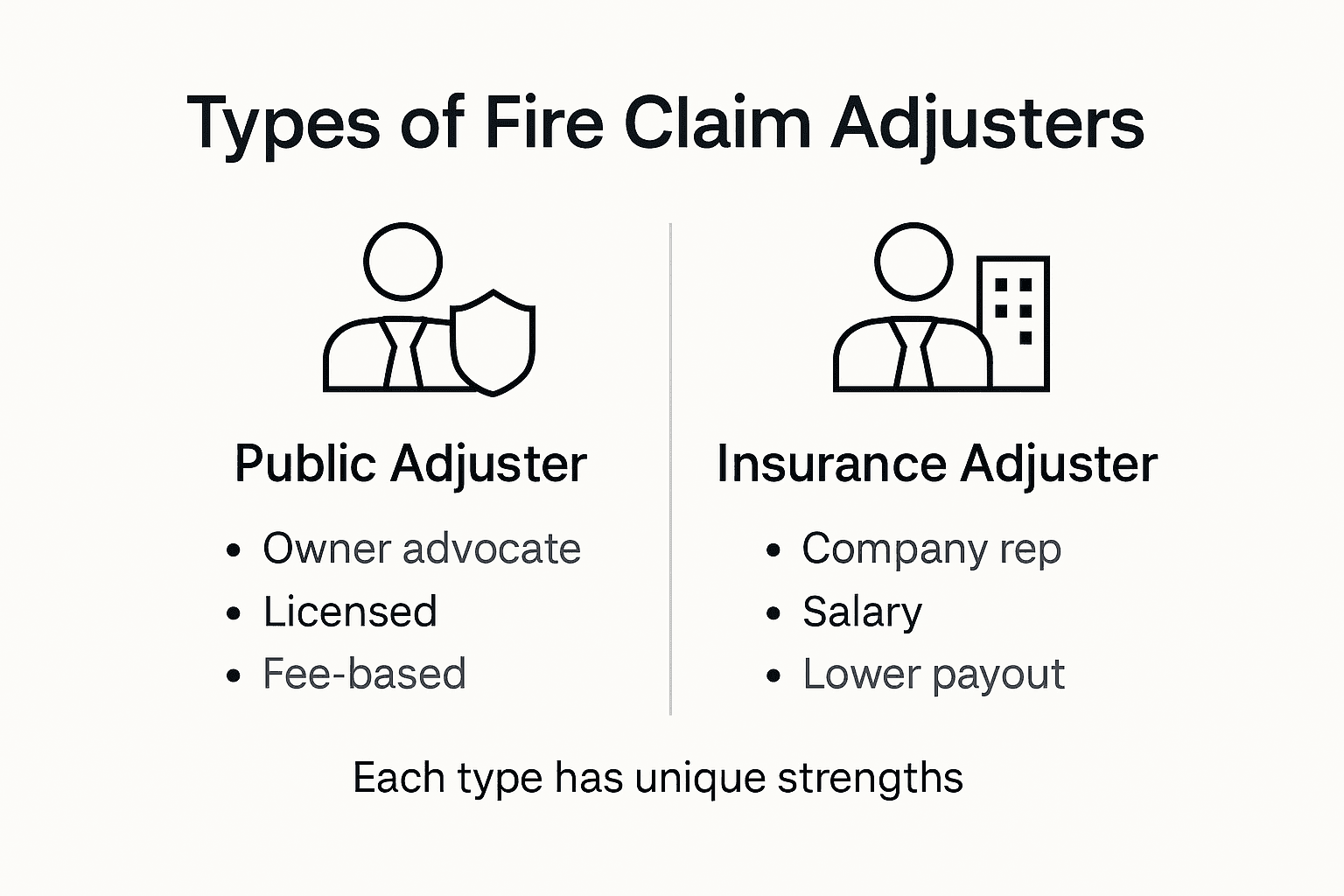
Here’s a concise comparison of fire claim adjuster roles and how each benefits property owners:
| Adjuster Type | Works For | Advantages for Owners | Limitations |
|---|---|---|---|
| Public | Property Owner | Maximizes claim payout, owner advocacy | Fees deducted from final settlement |
| Insurance Company | Insurer | Free service, quick assessment | May undervalue claim, insurer interests prioritized |
| Independent | Either party | Neutral assessment, flexible service | Loyalty depends on contracting party |
Pro tip: When facing a complex fire damage claim, consider consulting with a public adjuster in Atlanta who can provide a comprehensive, owner-focused damage assessment before accepting any initial settlement offer.
How Adjusters Assess and Value Fire Damage
Fire damage assessment is a complex and systematic process that requires meticulous attention to detail. Professional fire damage evaluators begin by conducting comprehensive property inspections that go far beyond surface-level observations. They carefully examine both visible and hidden damage, understanding that fire’s destructive impact extends well beyond charred surfaces and obvious structural compromises.
The damage assessment typically involves multiple critical steps. Adjusters first review the specific insurance policy to understand coverage limitations and potential compensation frameworks. They collaborate with fire investigators to determine the fire’s origin and cause, which can significantly impact claim validity. Detailed documentation becomes crucial, with adjusters creating extensive photographic evidence, comprehensive inventories of damaged property, and precise measurements of structural damage. This forensic approach helps quantify losses with scientific accuracy.

Calculating fire damage value requires specialized expertise in construction, restoration costs, and property valuation. Adjusters must differentiate between direct fire damage, smoke damage, and secondary damage like water destruction from firefighting efforts. They evaluate replacement costs, depreciation rates, and potential long-term structural compromises. Some damages, such as smoke infiltration into walls or electrical systems, may not be immediately apparent but can represent substantial financial losses requiring expert assessment.
Below is a summary of critical steps in professional fire damage assessment:
| Assessment Step | Purpose | Key Impact |
|---|---|---|
| Policy Review | Defines coverage terms | Identifies claim limits and exclusions |
| On-site Inspection | Documents visible/hidden damage | Supports evidence-based claim valuation |
| Expert Consultation | Clarifies cause and extent | Strengthens claim legitimacy |
| Damage Valuation | Estimates cost/replacement | Determines final settlement amount |
Pro tip: Photograph and document every aspect of fire damage immediately after the incident, creating a comprehensive visual record that will support your insurance claim and assist professional adjusters in their assessment.
Legal Standards and Licensing Requirements
Public adjusters in the United States operate within a complex regulatory framework that varies significantly across different states. Legal requirements for insurance claims professionals are designed to protect consumers and ensure professional standards are maintained through rigorous licensing and continuing education protocols.
Most states mandate specific licensing procedures for public adjusters, which typically involve comprehensive background checks, initial training programs, and ongoing professional development requirements. Licensing standards generally include passing state-administered examinations, demonstrating professional competence, and maintaining ethical conduct. Some jurisdictions require adjusters to carry professional liability insurance and submit to periodic professional audits to ensure compliance with state regulations.
The legal landscape for insurance claims professionals is dynamic and multifaceted. Different states impose varying requirements for initial licensing, renewal processes, and scope of practice. Public adjusters must navigate these complex regulatory environments, which can include restrictions on fee structures, mandatory disclosure requirements, and specific guidelines for client interactions. Some states have more stringent regulations that require additional certifications or specialized training for handling specific types of property damage claims, including fire-related losses.
Pro tip: Verify your public adjuster’s current state licensing status and professional credentials before engaging their services to ensure full legal compliance and professional competence.
Negotiation, Advocacy, and Settlement Process
Fire damage claim negotiations represent a complex strategic process where public adjusters serve as critical advocates for property owners. These professionals leverage extensive documentation, technical expertise, and deep understanding of insurance policy nuances to maximize potential settlements. Their primary objective is transforming a potentially adversarial claims process into a collaborative resolution that fairly compensates property owners for their devastating losses.
The negotiation process involves multiple sophisticated strategies. Public adjusters meticulously compile comprehensive evidence, including detailed damage assessments, repair estimates, replacement costs, and documentation of both structural and personal property losses. They frequently challenge initial insurance company evaluations by presenting alternative calculations, expert testimony, and forensic evidence that substantiate the full extent of fire-related damages. This approach requires not just technical knowledge, but exceptional communication and negotiation skills to effectively advocate for the property owner’s interests.
Successful settlement negotiations demand a nuanced understanding of insurance contract language, local building codes, and restoration requirements. Negotiation tactics often include presenting multiple layers of documentation, obtaining independent expert assessments, and strategically positioning the claim to demonstrate the full economic impact of the fire damage. Public adjusters must balance aggressive advocacy with professional diplomacy, creating compelling arguments that encourage insurance companies to provide fair and comprehensive compensation without triggering unnecessary legal confrontations.
Pro tip: Maintain a comprehensive file of all fire-related documentation, including photographs, receipts, and expert assessments, to provide your public adjuster with the strongest possible negotiation foundation.
Mistakes to Avoid and Tips for Success
Common pitfalls in fire damage insurance claims can significantly undermine property owners’ potential settlements. Property owners frequently make critical errors that reduce their chances of receiving comprehensive compensation. These mistakes often include delayed reporting, insufficient documentation, and accepting initial low-ball settlement offers without professional guidance.
The most frequent errors involve inadequate evidence collection and premature claim resolution. Homeowners might overlook critical damage documentation, fail to photograph all affected areas, or discard damaged items before proper assessment. Documentation strategies are paramount, requiring systematic evidence gathering that captures both visible and hidden damage. Professional public adjusters recommend creating comprehensive inventories, maintaining detailed repair estimates, and preserving all communication with insurance representatives.
Successful fire damage claims demand proactive and strategic approaches. Property owners should understand their specific insurance policy details, challenge initial assessments, and avoid making recorded statements without professional consultation. Hiring a public adjuster early in the process can prevent costly mistakes, as these professionals understand complex policy language and know how to effectively negotiate challenging claims. Strategic preparation includes maintaining organized records, understanding policy limitations, and being prepared to provide extensive documentation of losses.
Pro tip: Create a dedicated digital and physical file containing all fire-related documentation, including photographs, receipts, estimates, and correspondence, to provide your public adjuster with the most comprehensive claim support possible.
Maximize Your Fire Claim Settlement with Expert Public Adjusters
Fire damage claims involve complex challenges like detailed damage assessment, policy interpretation, and skilled negotiation. Homeowners often feel overwhelmed trying to navigate these processes alone, risking low settlements or missed compensation. This article highlights the importance of partnering with knowledgeable public adjusters who advocate solely for property owners and unlock every avenue for recovery.
At PublicAdjustersAtlanta.com, the licensed public adjusters we work with specialize in expertly reviewing your insurance policy, conducting comprehensive damage evaluations, and negotiating aggressively on your behalf to maximize your settlement. We understand the emotional toll of fire loss and provide clear, personalized guidance to protect your interests and ensure no damage goes undocumented.
Take control of your fire damage claim today and avoid costly mistakes. Explore our full range of services designed to deliver proven results.
Don’t accept a low insurance offer or struggle with confusing paperwork alone. Contact Public Adjusters Atlanta now for a free, no-obligation damage assessment and let us help you get the fair compensation you deserve.
Frequently Asked Questions
How do public adjusters help with fire claims?
Public adjusters work on behalf of property owners to document damage, interpret insurance policies, and negotiate settlements, ensuring that homeowners receive fair compensation for fire-related losses.
What are the differences between public adjusters and insurance company adjusters?
Public adjusters represent the property owner’s interests and aim to maximize claim payouts, while insurance company adjusters serve the insurer’s interests and may prioritize minimizing claim costs.
Why should I hire a public adjuster instead of handling my fire claim on my own?
Hiring a public adjuster can lead to significantly higher settlements due to their expertise in damage assessment, negotiation skills, and knowledge of insurance policies, which often outweighs the cost of their fees.
What mistakes should I avoid when filing a fire damage insurance claim?
Common mistakes include delaying the claim report, insufficient documentation of damages, and accepting low initial settlement offers. It’s crucial to gather comprehensive evidence and consult a public adjuster to avoid these pitfalls.
Recommended
- Role Of Licensed Adjusters – Maximizing Insurance Claims
- Insurance Claim Help – The Licensed Public Adjusters Atlanta GA
- Professional Fire Damage Claim Support | Metro Atlanta Public Adjusters
- What Is A Public Adjuster & When To Hire One | Public Adjuster Atlanta
- How Fire Protection Systems Lower Insurance Premiums?