

Denied insurance claims leave many Atlanta homeowners confused and frustrated, unsure who to turn to next. One path leads to a public adjuster, while another points to a lawyer, and understanding the differences can mean the difference between a quick resolution and a prolonged battle. This comparison breaks down the distinct roles of public adjusters and lawyers, giving you the clarity needed to protect your home and maximize your recovery.
Table of Contents
- What Public Adjusters and Lawyers Do
- Key Differences in Claims Handling
- Licensing, Qualifications, and Legal Boundaries
- When to Hire a Public Adjuster or Lawyer
- Costs, Risks, and Common Pitfalls
Key Takeaways
| Point | Details |
|---|---|
| Role of Public Adjusters | Public Adjusters assist homeowners with detailed documentation and negotiation in insurance claims, maximizing settlement potential. |
| Lawyers for Legal Interventions | Lawyers provide crucial legal representation when claims involve litigation, complex contract interpretation, or denial challenges. |
| Cost Structures | Public Adjusters usually charge a percentage of the claim settlement, while Lawyers may charge hourly rates or contingency fees, impacting overall costs. |
| When to Engage Professionals | Hire a Public Adjuster for claim preparation and negotiation, and a Lawyer for legal disputes or when negotiations fail. |
What Public Adjusters and Lawyers Do
When navigating complex insurance claims, understanding the distinct roles of public adjusters and lawyers is crucial for homeowners seeking fair compensation. These professionals offer different but complementary services in managing property damage insurance claims.
Public adjusters are licensed professionals who represent policyholders in insurance negotiations. Their primary responsibilities include:
- Thoroughly documenting property damage
- Conducting comprehensive damage assessments
- Preparing detailed claim documentation
- Negotiating directly with insurance companies
- Helping maximize potential claim settlements
Lawyers, by contrast, specialize in legal aspects of insurance claims that require formal legal intervention. Their role becomes critical when:
- Claims involve complex legal disputes
- Litigation is necessary
- Contract interpretations are required
- Insurance companies deny legitimate claims
Claim Documentation is where public adjusters excel. They meticulously compile evidence, photograph damages, estimate repair costs, and build a compelling case for maximum compensation. Unlike insurance company adjusters who represent the insurer’s interests, public adjusters work exclusively for the policyholder.
Lawyers step in when negotiations break down or legal complexities arise. They can file lawsuits, challenge claim denials through legal channels, and provide representation in formal dispute resolution processes.
Pro tip: Consider hiring a public adjuster first for claim documentation, and consult a lawyer if legal challenges emerge during the claims process.
Key Differences in Claims Handling
Navigating property damage insurance claims requires understanding the nuanced approaches of public adjusters and lawyers. While both professionals aim to help policyholders, their methods and expertise differ significantly in handling insurance claims.
Public adjusters represent policyholders during claim negotiations with a specific focus on maximizing insurance settlements. Their key characteristics include:
- Direct negotiation with insurance companies
- Comprehensive damage documentation
- Detailed cost estimation
- Advocating exclusively for the policyholder
- Expediting claim resolution process
Lawyers, conversely, approach claims from a legal perspective, becoming essential when disputes require formal legal intervention. Their primary responsibilities encompass:
- Interpreting complex insurance contract language
- Filing legal actions when negotiations fail
- Representing clients in litigation
- Challenging claim denials through legal channels
- Providing formal legal counsel
Compensation Approach distinguishes these professionals dramatically. Public adjusters typically work on contingency, earning a percentage of the final settlement, which incentivizes them to maximize claim values. Lawyers usually charge hourly rates or take cases on contingency for more complex legal challenges.

Legal counsel becomes critical when claim negotiations reach an impasse or involve significant legal complexities. While public adjusters focus on documentation and negotiation, lawyers can escalate matters to formal legal proceedings, providing a more aggressive approach to claim resolution.
Pro tip: Consider engaging a public adjuster first for comprehensive claim documentation, and reserve legal representation for situations requiring formal dispute resolution.
Licensing, Qualifications, and Legal Boundaries
Understanding the professional landscape of public adjusters and lawyers requires a deep dive into their distinct licensing requirements, qualifications, and legal boundaries. These professionals operate under different regulatory frameworks that define their scope of practice and professional responsibilities.
Public adjuster licensing is regulated at the state level, creating a complex patchwork of professional standards across different jurisdictions. Key licensing requirements typically include:
- Passing comprehensive state-administered examinations
- Completing mandatory pre-licensing education
- Obtaining professional liability insurance
- Submitting detailed background checks
- Maintaining ongoing continuing education credits
Lawyers, by contrast, must navigate a more rigorous credentialing process. Their professional qualifications involve:
- Completing a three-year law degree
- Passing the state bar examination
- Meeting strict ethical standards
- Maintaining ongoing legal education requirements
- Demonstrating comprehensive legal knowledge
Legal Boundaries represent a critical distinction between these professionals. Public adjusters are strictly limited to negotiating insurance claims, while lawyers possess broader legal authority to represent clients in multiple legal contexts. This fundamental difference means public adjusters cannot provide legal advice or represent clients in court proceedings.
Most states have specific regulations that exempt attorneys from traditional adjuster licensing when they are acting in their professional legal capacity. This exemption underscores the unique legal authority that lawyers maintain compared to public adjusters, who are narrowly focused on insurance claim negotiations.
Pro tip: Always verify a professional’s current licensing status and specific qualifications before engaging their services for your insurance claim.
For quick reference, here is a table outlining licensing and qualifications for public adjusters and lawyers:
| Credential Area | Public Adjuster | Lawyer |
|---|---|---|
| Educational Requirement | State-approved coursework | Juris Doctor degree |
| Exam Needed | State adjuster exam | State bar exam |
| Ongoing Training | State CE credits | Continuing legal education |
| Legal Advice | Not permitted | Fully authorized |
| Court Representation | Not allowed | Allowed in all courts |
When to Hire a Public Adjuster or Lawyer
Deciding between a public adjuster and a lawyer depends on the specific complexities of your insurance claim. Understanding when to engage each professional can significantly impact your claim’s outcome and potential settlement.
Public adjusters are ideal for large property damage claims where specialized negotiation skills can maximize your settlement. Consider hiring a public adjuster when:
- Property damage exceeds $10,000
- Claims involve complex damage assessment
- You need comprehensive damage documentation
- Insurance company offers seem unreasonably low
- Professional negotiation could increase settlement
Lawyers become essential in more legally intricate situations. You should engage a lawyer when:
- Insurance claim involves potential litigation
- Claim requires complex legal interpretation
- Dispute involves third-party liability
- Previous negotiations have reached an impasse
- Allegations of insurance bad faith emerge
Claim Complexity determines the most appropriate professional support. Public adjusters excel at detailed claim preparation and negotiation, working on a contingency basis that aligns their interests with yours. Lawyers provide critical legal recourse when claims require formal dispute resolution, offering broader legal strategies beyond claim negotiation.
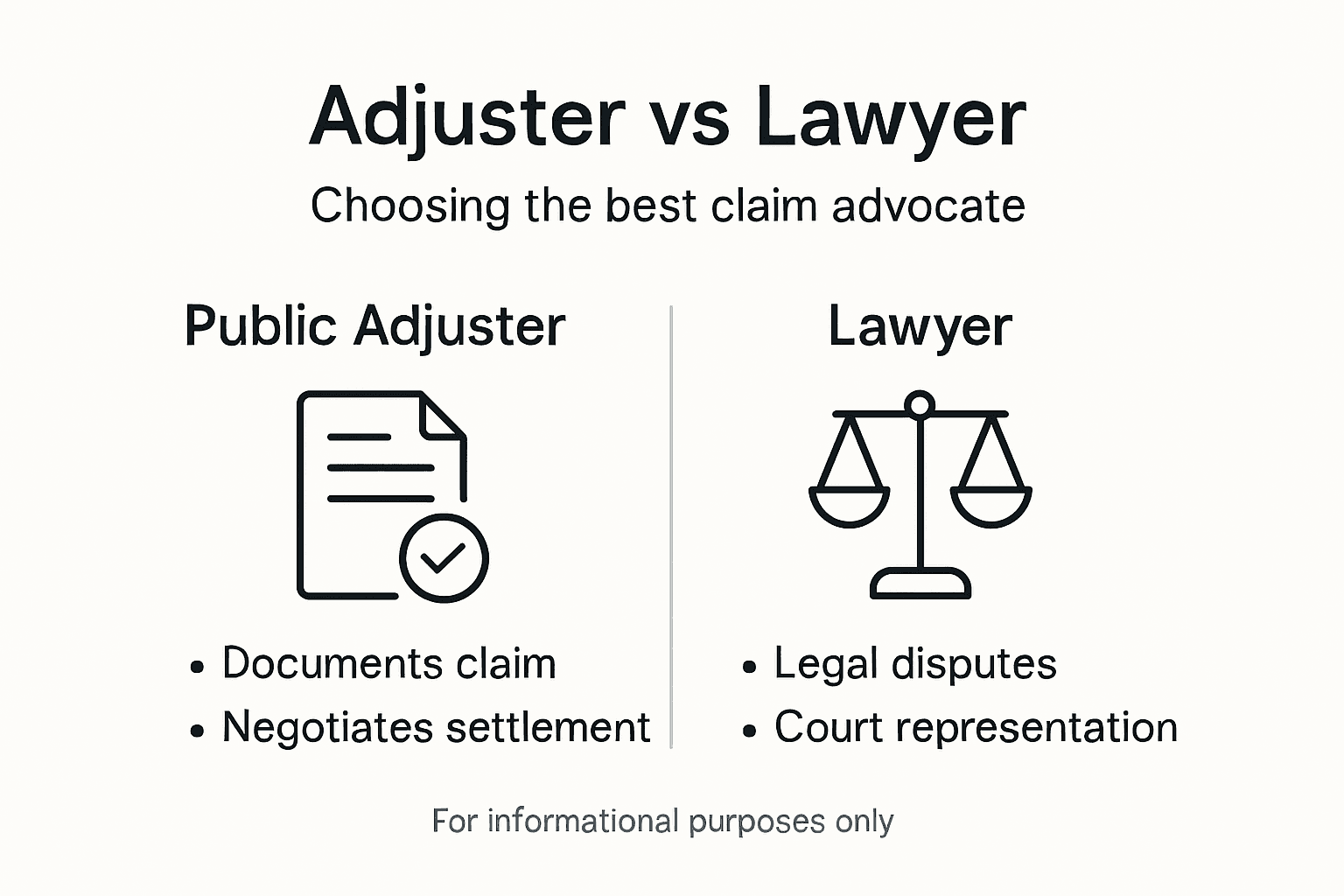
Financial considerations also play a crucial role. Public adjusters typically charge a percentage of the final settlement, while lawyers often bill hourly or take cases on contingency. This difference can significantly impact your total recovery and out-of-pocket expenses.
Pro tip: Consider a free consultation with both a public adjuster and a lawyer to determine the most strategic approach for your specific insurance claim.
Here’s a concise comparison of when to engage a public adjuster versus a lawyer:
| Scenario | Public Adjuster Best For | Lawyer Best For |
|---|---|---|
| Initial claim preparation | Maximizing settlement through documentation | Not typically needed |
| Policy interpretation | Basic coverage explanations | Complex contract analysis |
| Persistent claim denial | Negotiating further with insurer | Challenging denial in court |
| Suspected bad faith | Negotiating higher offers | Filing lawsuits against insurer |
| Legal deadlines | Not authorized to advise | Ensuring deadlines are met |
Costs, Risks, and Common Pitfalls
Navigating insurance claims involves understanding the financial implications and potential risks associated with hiring public adjusters and lawyers. Each professional brings unique cost structures and potential challenges that homeowners must carefully consider.
Public adjusters typically charge 10-20% of the insurance settlement, creating a complex financial landscape. Their fee structure includes:
- Percentage-based compensation
- No upfront out-of-pocket expenses
- Incentive to maximize claim value
- Performance-driven payment model
- Transparent fee agreements
Lawyers present alternative cost considerations with different risk profiles:
- Hourly billing rates
- Contingency fee arrangements
- Potential for higher total legal expenses
- Complex fee structures
- Additional litigation costs
Risk Assessment becomes crucial when selecting professional representation. State regulations help protect policyholders from potential fee disputes, but several common pitfalls exist. Potential risks include:
- Hiring unlicensed professionals
- Misunderstanding fee structures
- Overpaying for minimal claim assistance
- Prolonged claim resolution timelines
- Potential conflicts of interest
Some professionals may exploit complex claim processes, making due diligence essential. Homeowners should carefully review credentials, verify licensing, and understand complete fee structures before engaging any claims professional.
Pro tip: Request detailed written agreements and compare multiple professional consultations to ensure transparent and fair representation.
Choose the Right Advocate for Your Insurance Claim and Maximize Your Settlement
Facing a property damage insurance claim can be overwhelming, especially when deciding whether to hire a public adjuster or a lawyer. The article highlights common challenges such as claim documentation, complex legal disputes, and negotiating fair settlements. If you want expert help negotiating your insurance claim and ensure full compensation without the stress of legal battles, professional public adjusters are your best choice.
At Public Adjusters Atlanta, the licensed public adjusters we work with specialize in thorough damage assessments, detailed claim review, and skilled negotiation with insurance companies. We focus solely on representing homeowners and businesses in the Atlanta area to help you navigate the complicated claims process and avoid costly pitfalls.
Don’t let confusion over claim handling slow your recovery. Benefit from personalized advocacy and transparent service by reaching out today. Visit Public Adjusters Atlanta now and start with a free damage evaluation to take the first step toward maximizing your insurance settlement.
Frequently Asked Questions
What is the main role of a public adjuster in insurance claims?
Public adjusters represent policyholders during insurance negotiations, focusing on thoroughly documenting property damage, preparing detailed claim documentation, and maximizing potential settlements by negotiating directly with insurance companies.
When should I hire a lawyer for my insurance claim?
You should engage a lawyer when your claim involves complex legal disputes, requires litigation, or when the insurance company has denied your claim. Lawyers can also help with contract interpretation and provide representation in formal legal proceedings.
How do public adjusters and lawyers differ in terms of costs?
Public adjusters typically charge a percentage of the insurance settlement (usually 10-20%), while lawyers may charge an hourly rate or work on a contingency basis for more complex cases, potentially leading to higher total expenses.
Can a public adjuster provide legal advice or represent me in court?
No, public adjusters cannot provide legal advice or represent clients in court. They focus solely on negotiating insurance claims while lawyers have the authority to handle legal matters and represent clients in legal proceedings.
Recommended
- Public Adjusters Atlanta GA | Public Adjusters Georgia
- Atlanta’s Best Claim Lawyer – Property Damage Claim Lawyer In USA
- Role Of Licensed Adjusters – Maximizing Insurance Claims
- Claim Lawyer Atlanta GA – Professional Insurance Claim Lawyers USA
- Insurance-Approved Locks: Security and Compliance Explained