

Facing fire or water damage in your Atlanta home can leave you feeling overwhelmed long before the paperwork even starts. Insurance adjusters step in at this crucial moment, working to investigate property loss, determine coverage, and recommend settlement amounts. Knowing whether an adjuster is acting for you or the insurance company makes a direct difference in your compensation. This article explains the roles of insurance adjusters, the unique value of public adjusters, and how you can protect your interests for a fair property claim.
Table of Contents
- Insurance Adjusters: Their Core Responsibilities
- Types Of Adjusters And Key Differences
- How Adjusters Evaluate And Negotiate Settlements
- Legal And Ethical Obligations Of Adjusters
- Risks Of DIY Claims And Mistakes To Avoid
Key Takeaways
| Point | Details |
|---|---|
| Understanding Adjusters | Insurance adjusters evaluate claims, determining compensation based on damage assessment and policy coverage. Knowing their role helps you identify their alignment with your interests. |
| Types of Adjusters | There are three main types of adjusters: staff adjusters work for insurers, independent adjusters contract for multiple companies, and public adjusters advocate exclusively for policyholders. Choosing the right type can significantly impact your settlement. |
| Negotiate with Knowledge | Professional representation, especially by a public adjuster, can maximize your settlement by analyzing damage, documentation, and policy language effectively. Understanding your rights and leveraging expertise is crucial for fair compensation. |
| Document Everything | Before making repairs, document all damages thoroughly and obtain adjuster reports. Avoid making assumptions about coverage and settlement amounts, as misinformation can lead to significant financial losses. |
Insurance Adjusters: Their Core Responsibilities
Insurance adjusters serve as the backbone of the claims process, evaluating damage claims and determining how much compensation you should receive. Whether you’re dealing with fire damage in your Marietta home or water damage in an Atlanta property, adjusters play a critical role in assessing losses and navigating the path to fair settlement. Understanding what these professionals actually do helps you recognize whether they’re working in your best interest or the insurance company’s.
At their core, insurance claims adjusters evaluate claims to determine compensation for policyholders by assessing property damage, interviewing witnesses, and ensuring compliance with legal and ethical standards. When you file a claim after a loss, an adjuster investigates the claim details, documents the extent of damage, determines what your policy covers, and ultimately recommends a settlement amount. They inspect damaged buildings and property, gather information from you and other relevant parties, and compile this evidence into a formal assessment. This investigative process requires technical knowledge, attention to detail, and the ability to interpret complex insurance policies. Most adjusters work full time and often spend significant time in the field, examining damaged properties in person rather than just reviewing photos or reports from a distance.
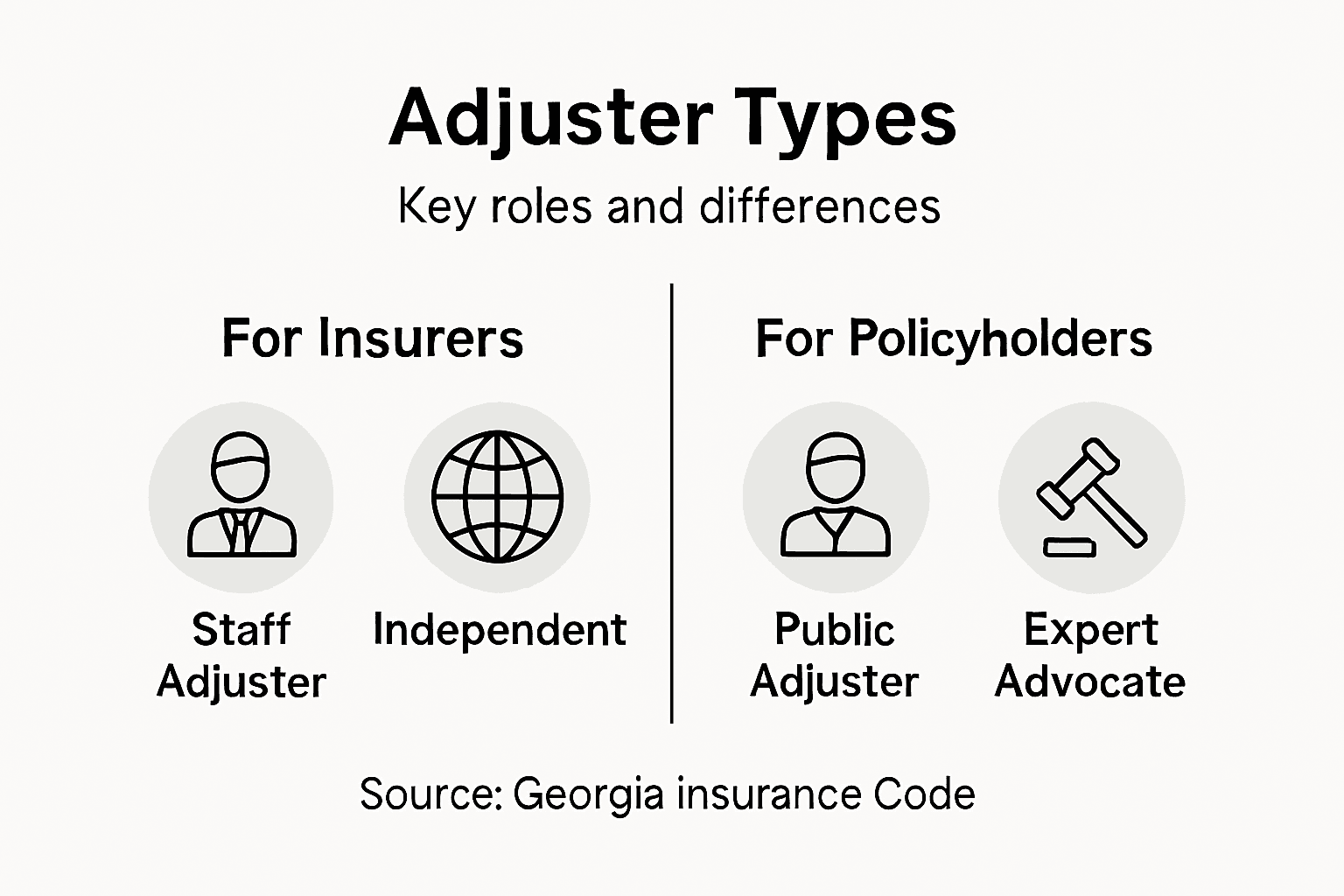
There are different types of adjusters operating in Georgia’s insurance marketplace, and knowing which one you’re dealing with matters significantly. Staff adjusters work directly for insurance companies and evaluate claims on the insurer’s behalf. Independent adjusters handle claims for multiple insurance companies on a contract basis. Public adjusters, by contrast, represent you, the policyholder, and work exclusively to maximize your settlement. This distinction is crucial because staff and independent adjusters have incentives that may not align with yours. They’re trained to investigate claims and negotiate settlements, but their loyalty ultimately lies with the insurance company paying their fees. Public adjusters flip this dynamic entirely, bringing expertise in claim evaluation and settlement negotiation while advocating specifically for your interests.
When an adjuster arrives at your property, they’re conducting what amounts to a forensic inspection. They photograph damage, measure affected areas, review your policy terms, and assess the cost of repairs or replacement. They may consult with contractors, engineers, or other experts depending on the complexity of your claim. For Atlanta homeowners dealing with fire damage, an adjuster evaluates structural integrity, contents loss, and temporary living expenses. For water damage claims, they assess mold risk, structural deterioration, and the full scope of affected materials. All of this feeds into their final recommendation for settlement amount. The thoroughness of this process directly impacts whether you receive adequate compensation or leave money on the table.
Below is a summary of how adjusters interact with property claims at each major stage:
| Claim Stage | Adjuster Action | Impact on Policyholder |
|---|---|---|
| Initial Inspection | Assess damage and collect documentation | Sets foundation for settlement amount |
| Policy Review | Interpret coverage terms and exclusions | Identifies what is and is not covered |
| Damage Valuation | Calculate repair/replacement costs | Determines size of compensation offer |
| Negotiation | Present findings and discuss settlement | Influences final payout and resolution |
| Final Settlement | Recommend or adjust settlement amount | Closes claim with payout or dispute |
Pro tip: Request copies of the adjuster’s inspection report and all supporting documentation as soon as they’re completed, and consider having a public adjuster review their findings to identify any underestimated damage or missed coverage items before you accept any settlement offer.
Types Of Adjusters And Key Differences
Not all adjusters work for you. This fundamental truth shapes your entire claims experience. Understanding the three types of adjusters operating in Georgia’s insurance system is essential because each one operates with different loyalties, incentives, and goals. The type of adjuster handling your claim can mean thousands of dollars difference in your final settlement, so knowing who you’re dealing with matters more than most homeowners realize.
Staff adjusters (also called company adjusters) are salaried employees hired directly by insurance companies. They evaluate claims exclusively for their employer, meaning they have no incentive to maximize your settlement. Their job is to close claims efficiently while protecting the insurer’s bottom line. When a staff adjuster inspects your Atlanta fire damage claim or your Marietta water damage, they’re working within parameters set by their employer to minimize payouts. These adjusters receive steady paychecks regardless of settlement amounts, but their performance evaluations often reflect how quickly they close cases and how low they can settle them. Independent adjusters contract with multiple insurance companies and are typically called in during peak claim periods like after major storms or disasters. They’re freelancers who get hired when insurers are overwhelmed, handling claims for various companies on a temporary basis. Like staff adjusters, their loyalty remains with the insurance carriers paying them, not with you.
Public adjusters represent policyholders exclusively and work to maximize your claim settlement. This is the critical difference. A public adjuster in Atlanta or the surrounding counties advocates specifically for your interests, not the insurance company’s. They investigate damage thoroughly, identify all applicable coverage under your policy, and negotiate aggressively to ensure you receive fair compensation. Public adjusters typically work on contingency, meaning they’re only paid if your settlement increases, and they take a percentage of that increase. This compensation model aligns their interests directly with yours. The more they recover for you, the more they earn.
The comparison table below illustrates how these three types differ across key dimensions:
- Employment: Staff adjusters work for insurers; independent adjusters contract with multiple insurers; public adjusters work for you alone
- Loyalty: Staff and independent adjusters represent insurance companies; public adjusters advocate exclusively for policyholders
- Compensation: Staff adjusters earn salaries; independent adjusters bill hourly rates to insurers; public adjusters work on contingency fees
- Motivation: Staff adjusters minimize payouts; independent adjusters process claims efficiently for their client insurers; public adjusters maximize your settlement
When you file a claim after fire or water damage, you have the right to hire a public adjuster to represent your interests throughout the process. Many Atlanta homeowners don’t realize this option exists, leaving them to negotiate directly with staff adjusters who have institutional pressure to settle quickly and low. The presence of a public adjuster often changes the entire dynamic of negotiations. Insurance companies recognize that public adjusters know policy language deeply, understand construction costs, and won’t accept lowball offers.
Pro tip: Contact a public adjuster immediately after significant property damage occurs, before meeting with the insurer’s staff adjuster, so your advocate can be present during the initial inspection and ensure nothing is missed or undervalued.
How Adjusters Evaluate And Negotiate Settlements
The process of evaluating damage and determining what you receive is far more nuanced than simply looking at a damaged property and writing a check. When an adjuster arrives at your Atlanta home after fire damage or your Decatur property following flooding, they’re executing a systematic evaluation process that directly impacts your settlement amount. Understanding how this process works helps you recognize whether valuations are accurate or if critical damage has been overlooked.

Adjusters begin by investigating the claim thoroughly, which means reviewing all documentation you’ve submitted, examining your insurance policy word by word, and conducting a detailed physical inspection of the damaged property. They photograph damage from multiple angles, measure affected areas, and take notes on the extent of loss. During this inspection, they’re gathering evidence that will support their settlement recommendation. Adjusters assess claim validity by investigating damages and reviewing policy terms to determine exactly what your coverage includes and excludes. They may interview you, witnesses, contractors, or other relevant parties to build a complete picture of what happened and the financial impact. This investigation phase is critical because gaps in documentation or overlooked damage can directly reduce your final settlement. If an adjuster doesn’t photograph water damage in your attic or doesn’t document mold growth in your walls during the initial inspection, proving that damage later becomes exponentially harder.
Once the investigation concludes, adjusters calculate damage valuation by applying several factors that can significantly reduce your settlement if not carefully scrutinized. Depreciation is the big one. If your ten-year-old roof was damaged in a fire, the adjuster doesn’t pay to replace it with a new roof. Instead, they calculate what that roof was worth at the time of loss, accounting for its age and wear. They also factor in your deductible, which comes directly out of your settlement. An adjuster might determine that water damage repairs cost $15,000 total, but with your $2,500 deductible, your settlement offer becomes $12,500. They review your policy limits to ensure they don’t exceed what you’re actually covered for. This valuation work requires technical expertise in construction costs, material pricing, and local labor rates. A public adjuster brings this same technical knowledge but approaches the numbers differently, often identifying underestimated repair costs or policy coverage areas the insurer’s adjuster missed.
Negotiations happen when there’s disagreement between your claim value and the insurer’s initial settlement offer. Staff adjusters working for insurance companies have limited authority to increase their initial offers without approval from management. Public adjusters, by contrast, can negotiate aggressively because they have no incentive to minimize payouts. During negotiations, adjusters communicate their valuation methodology with supporting documentation like contractor estimates, repair quotes, and photographic evidence. They remain open to discussions but defend their positions with data. Getting settlement amounts that reflect your actual coverage and contractual rights requires having someone in the room who knows how to challenge lowball valuations and identify policy language that supports your position.
Pro tip: Obtain at least two independent contractor estimates before accepting any settlement offer, and provide these estimates to your adjuster to demonstrate that their valuation may be below actual repair costs for your specific property and damage type.
Legal And Ethical Obligations Of Adjusters
Adjusters operate within a framework of legal requirements and ethical standards that exist specifically to protect you. These aren’t suggestions or guidelines. They’re binding obligations enforced by state regulators, professional licensing boards, and the courts. Understanding what adjusters are legally required to do gives you a concrete way to hold them accountable if they fall short.
Licensing and compliance requirements vary by state, but Georgia requires all adjusters to be licensed and maintain that license through continuing education. Insurance adjusters are bound by ethical standards requiring honesty, fairness, confidentiality, and competence in their claims handling activities. This means an adjuster evaluating your Atlanta fire damage claim must conduct an honest investigation, not a cursory walkthrough designed to minimize your payout. They’re required to treat you fairly and maintain confidentiality about details you share during the claims process. They cannot have conflicts of interest that would bias their evaluation. If an adjuster owns a preferred contractor and steers you toward that contractor while knowing a competitor offers better pricing, that’s an ethical violation. Ongoing education requirements ensure adjusters stay current on evolving regulations, coverage types, and valuation methodologies. Violations of these ethical standards can result in license suspension or revocation, professional discipline, and legal consequences.
Beyond ethical obligations, adjusters have specific legal responsibilities that create accountability. The legal responsibilities of insurance adjusters include accurate investigation and documentation of claims while adhering to licensing regulations and complying with fiduciary duties to act in good faith. This is significant because it means adjusters owe you transparency and fair treatment, not just the insurer. They must investigate your claim thoroughly, document their findings accurately, and communicate their methodology clearly. They cannot ignore damage, overlook policy coverage, or make assumptions without evidence. When disputes arise, these documented investigations often end up in court, with adjusters sometimes serving as expert witnesses defending their claim valuations.
Fiduciary duty is where things get interesting. While staff adjusters work for insurance companies, they still owe claimants a duty of good faith. This means they cannot deliberately misrepresent damage, apply policy terms dishonestly, or withhold information that affects your settlement. A staff adjuster cannot know that your policy covers contents replacement but deliberately exclude it from their offer. That would violate their good faith obligation. Public adjusters have even stronger obligations because they’re representing you directly. They cannot negotiate settlements that undervalue your claim or recommend policy interpretations that harm your interests. These legal and ethical obligations mean that when an adjuster provides a settlement recommendation, you’re entitled to expect it reflects an honest evaluation of your damage and coverage.
What happens when adjusters violate these obligations? Civil liability, license revocation, and lawsuits. If an adjuster’s negligent investigation causes you financial harm, you may have grounds for a lawsuit. If they violate ethical standards egregiously, state regulators can revoke their license, effectively ending their career. This enforcement mechanism exists to protect you. It creates incentive for adjusters to do their jobs properly.
Pro tip: Request documentation of every step in the adjuster’s investigation process, including photos, measurements, policy interpretations, and damage assessments, and have a public adjuster review this documentation to identify any gaps or ethical violations that might support a higher settlement.
Risks Of DIY Claims And Mistakes To Avoid
The instinct to handle your own insurance claim seems reasonable until you realize you’re negotiating against people trained specifically to minimize payouts. DIY claims look cheap upfront, but they cost you thousands in the long run through documentation gaps, underestimated damages, and settlement rejections. Atlanta homeowners who attempt to navigate fire or water damage claims alone consistently receive lower settlements than those with professional representation. Understanding the specific risks helps you recognize why professional help is investment, not expense.
Documentation failures are where most DIY claims fall apart. When you report damage to your insurer without a public adjuster present, you’re describing loss from memory while stressed about your home. You might forget to mention the water damage in your attic because you haven’t fully assessed the property. You might underestimate repair costs because you don’t know what construction materials currently cost in Georgia’s market. An adjuster arrives and photographs only visible damage because you didn’t point out hidden mold or structural issues. Months later when you discover water damage behind walls, proving that damage was part of the original loss becomes exponentially harder. Handling insurance claims without professional help poses risks such as inadequate documentation and underestimating damages, leading to disputes or reduced settlements. A public adjuster conducts a systematic damage assessment, documenting every affected area with photographs, measurements, and detailed notes that create an evidentiary record the insurer cannot later dispute.
Premature repairs create a different category of problems. You see fire damage to your kitchen and want to start repairs immediately to get your life back to normal. But when you remove damaged materials or begin reconstruction before the adjuster completes their assessment, you’re destroying evidence of the original loss. The adjuster cannot photograph what no longer exists. Insurance companies require proof of professional repairs for major systems like electrical, plumbing, and structural work. DIY home repair projects can jeopardize insurance claims if work is unpermitted, fails to meet building codes, or involves poor workmanship. If you repair electrical damage yourself and the work fails to meet code, your insurer may deny coverage for related damage or refuse to insure your home moving forward. Some insurance policies specifically exclude coverage for unpermitted DIY work, leaving you bearing the full cost of repairs that should have been covered.
Valuation errors happen when homeowners unfamiliar with replacement costs attempt to estimate repair expenses. You get three contractor quotes and they vary wildly. Without expertise in understanding why costs differ and which estimate is most reliable, you choose the lowest price. But the lowest price often reflects inferior materials or inexperienced contractors who cut corners. When you later need to rebuild, you discover you’re thousands short. A public adjuster understands construction costs, knows which contractors provide quality work at reasonable prices, and can verify that your repair estimates reflect actual replacement costs in your area. They also understand depreciation calculations and policy limits in ways that allow them to identify coverage the insurer’s adjuster overlooked.
Policy interpretation mistakes are subtle but costly. Your homeowners policy contains language about what is and isn’t covered. You read it and think you understand. But insurance policies use technical language and cross-references that create coverage in unexpected places. A public adjuster reads these same policies and identifies coverage for contents replacement, temporary housing, or additional living expenses that you missed entirely. They understand how to apply policy language to your specific damage scenario in ways that maximize your compensation.
Here are potential mistakes of DIY claims and the professional advantage to each risk:
| DIY Claim Risk | How It Hurts Settlement | Professional Advantage |
|---|---|---|
| Incomplete Documentation | May exclude hidden damages | Public adjusters document thoroughly |
| Premature Repairs | Destroys key evidence | Professionals ensure all proof kept |
| Underestimated Valuation | Leads to insufficient settlements | Experts assess true costs |
| Policy Misinterpretation | Misses available coverage | Adjusters identify hidden benefits |
Pro tip: Stop all repairs immediately after property damage occurs, document the damage thoroughly with photos and video from multiple angles, and contact a public adjuster before meeting with the insurance company’s adjuster so your advocate can ensure nothing is missed during the initial damage assessment.
Protect Your Rights With Expert Public Adjusters in Atlanta
The role of insurance adjusters in your settlement can be complex and overwhelming. This article revealed common challenges homeowners face such as underestimated damage assessments, policy misinterpretation, and lowball offers from staff adjusters loyal to insurance companies. These pain points often result in unfair compensation that does not cover the true cost of your fire, water, storm, or other property damage. You deserve dedicated professionals who put your interests first and fight to maximize your claim settlement.
At Public Adjusters Atlanta, the licensed public adjusters we work with specialize in thorough claim evaluation, detailed damage documentation, and aggressive negotiation tailored to your unique situation. We act as your personal advocates to prevent premature repairs from ruining evidence, decipher complex policy language, and ensure every eligible expense is recovered. Don’t risk leaving money on the table or facing stress navigating insurance bureaucracy alone.
Get the full compensation you deserve by teaming up with experts who understand the crucial role adjusters play in the claims process. Contact us today at Public Adjusters Atlanta to schedule your free damage evaluation and take control of your insurance settlement now.
Frequently Asked Questions
What is the primary role of an insurance adjuster in the claims process?
Insurance adjusters evaluate damage claims, assess the extent of property losses, and determine the appropriate compensation amount based on the insurance policy.
How do the different types of adjusters affect my claim settlement?
There are three main types of adjusters: staff adjusters work for the insurance company, independent adjusters are contracted by multiple insurers, and public adjusters represent policyholders. Public adjusters focus on maximizing your settlement, while staff and independent adjusters may prioritize minimizing payouts for the insurer.
What steps should I take when an adjuster inspects my property?
Document the damage thoroughly with photos and videos from multiple angles, and consider having a public adjuster present during the inspection to ensure no damages are overlooked and to advocate for your best interests.
Why is it important to hire a public adjuster?
Hiring a public adjuster can significantly increase your settlement amount, as they specialize in thoroughly documenting damages and negotiating with insurance companies to ensure you receive fair compensation.