

A major property loss in Atlanta can turn a homeowner’s world upside down, especially when fire or water damage sweeps through valued spaces. The insurance claims process for these large losses is not just overwhelming but also filled with critical decisions that directly affect your financial recovery. With so much at stake, understanding the roles of specialized adjusters in large loss claims gives you the advantage and guidance needed to protect your interests and secure the best possible outcome.
Table of Contents
- Defining Large Losses And Adjuster Roles
- Types Of Adjusters Involved In Major Claims
- Step-By-Step Process For Large Loss Claims
- Key Differences: Public Vs. Insurance Adjusters
- Common Pitfalls And How To Avoid Them
Key Takeaways
| Point | Details |
|---|---|
| Role of Adjusters | Different types of adjusters, including company, independent, and public adjusters, play crucial roles in navigating large loss insurance claims. Each type has unique responsibilities and focuses on various aspects of the claim process. |
| Documentation Importance | Comprehensive documentation of damage and communication is essential for successful claim negotiations. Maintaining detailed records significantly strengthens the position of the policyholder. |
| Mitigating Pitfalls | Common pitfalls in large loss claims include incomplete documentation and communication breakdowns. Proactive strategies such as thorough evidence collection and clear communication channels can help avoid these issues. |
| Expert Involvement | Engaging specialized adjusters and technical experts can enhance the claim process and ensure accurate assessments, particularly in complex scenarios involving catastrophic losses. |
Defining Large Losses and Adjuster Roles
Insurance claims involving large losses represent complex financial challenges that require specialized professional intervention. Claims adjusters investigating complex settlements play a critical role in navigating these intricate scenarios, serving as essential intermediaries between insurance providers and claimants.
Large losses typically encompass high-value insurance claims that exceed standard processing protocols. These complex claims often emerge from significant events such as natural disasters, major property damage, industrial accidents, or comprehensive theft scenarios. The financial stakes are substantially higher, requiring detailed investigation, precise documentation, and strategic negotiation.
The roles of adjusters in managing large losses include several key responsibilities:
- Thoroughly investigating claim circumstances
- Conducting comprehensive damage assessments
- Documenting detailed evidence and financial impact
- Negotiating fair settlements with multiple stakeholders
- Coordinating communication between insurance companies and claimants
Public adjusters specialize in representing property owners during these complex claim processes. Unlike insurance company adjusters, they work exclusively on behalf of the policyholder to ensure maximum potential compensation. Their expertise becomes particularly crucial when dealing with extensive property damage or catastrophic loss scenarios.
Large loss adjusters transform complicated insurance claims into manageable resolution processes, bridging critical communication gaps between insurers and claimants.
Pro tip: Always document every detail of property damage thoroughly, as comprehensive evidence significantly strengthens your insurance claim negotiation position.
Types of Adjusters Involved in Major Claims
In the complex world of insurance claims, different types of adjusters play critical roles in managing large loss scenarios. Insurance adjusters with specialized classifications operate across multiple categories, each serving a unique function in the claims resolution process.
The primary types of adjusters involved in major claims include:
- Company Adjusters: Employed directly by insurance providers, these professionals handle claims internally for their specific organization
- Independent Adjusters: Contract professionals who work with multiple insurance companies, offering flexibility and specialized expertise
- Public Adjusters: Advocates exclusively representing policyholders’ interests during complex claim negotiations
Each adjuster type brings distinct advantages to large loss claim scenarios. Company adjusters provide deep institutional knowledge and immediate resource access, while independent adjusters offer broader perspective and specialized technical skills. Public adjusters uniquely focus on maximizing policyholder compensation, ensuring thorough and fair claim evaluations.
Catastrophic loss adjusters represent a specialized subcategory particularly crucial in major claim scenarios. These professionals possess advanced technical skills to assess extensive damages resulting from natural disasters, industrial accidents, or widespread property destruction. Their expertise becomes invaluable when claims involve multi-million dollar assessments and complex investigation requirements.
Complex insurance claims demand nuanced expertise that goes far beyond simple damage assessment, requiring sophisticated negotiation and detailed documentation skills.
The selection of an appropriate adjuster type depends on multiple factors, including claim complexity, financial stakes, and specific policyholder needs. Large losses often require collaborative approaches involving multiple adjuster types to ensure comprehensive claim resolution.

Here’s a quick comparison of adjuster types and their core focus in large loss claims:
| Adjuster Type | Primary Goal | Typical Employers | Best Used For |
|---|---|---|---|
| Company Adjuster | Protect insurer’s financial position | Insurance companies | Internal claims, policy compliance |
| Independent Adjuster | Balance efficiency and expertise | Multiple insurers/agencies | Complex/multistakeholder claims |
| Public Adjuster | Maximize claim for policyholder | Policyholders | Major losses, disputed settlements |
| Catastrophic Adjuster | Handle high-severity, large-scale events | Insurers & agencies | Natural disasters, industrial events |
Pro tip: Always verify an adjuster’s credentials and specific experience with claims similar to your own before initiating the claims process.
Step-By-Step Process for Large Loss Claims
Navigating a large loss insurance claim requires a systematic and strategic approach. Loss adjustment processes involve multiple critical stages that demand careful attention and professional expertise to ensure comprehensive claim resolution.
The comprehensive large loss claim process typically follows these key stages:
Initial Loss Notification
- Contact insurance provider immediately
- Provide preliminary details about the damage
- Preserve evidence and document initial observations
Adjuster Assignment
- Insurance company dispatches specialized loss adjuster
- Adjuster reviews preliminary claim information
- Schedules comprehensive damage assessment
Damage Investigation and Documentation
- Conduct thorough on-site property inspection
- Capture detailed photographic and written evidence
- Evaluate extent of damages
- Consult with technical experts if necessary
Damage Assessment and Valuation
- Calculate precise repair or replacement costs
- Compare damages against policy coverage
- Develop comprehensive damage report
Negotiation and Settlement
- Present detailed claim documentation
- Negotiate fair compensation
- Resolve potential disputes
Catastrophic loss claims often involve more complex investigations that may require extended timelines and specialized expert consultations. These claims demand meticulous documentation and sophisticated negotiation strategies to ensure fair and accurate compensation.
Large loss claims are not simply about filing paperwork, but about strategically documenting and presenting a comprehensive narrative of the property damage.
Successful large loss claims require patience, detailed documentation, and often professional representation to navigate the intricate insurance landscape effectively. Each stage demands specific expertise and strategic approach to maximize potential compensation.
Pro tip: Maintain a comprehensive digital and physical file of all claim-related documentation, including photographs, estimates, and communication records.
Key Differences: Public vs. Insurance Adjusters
Insurance claims involve complex interactions between different types of adjusters, each serving distinct roles and representing unique interests. Insurance adjusters with contrasting perspectives play critical parts in the claims resolution process, fundamentally differing in their primary objectives and allegiances.
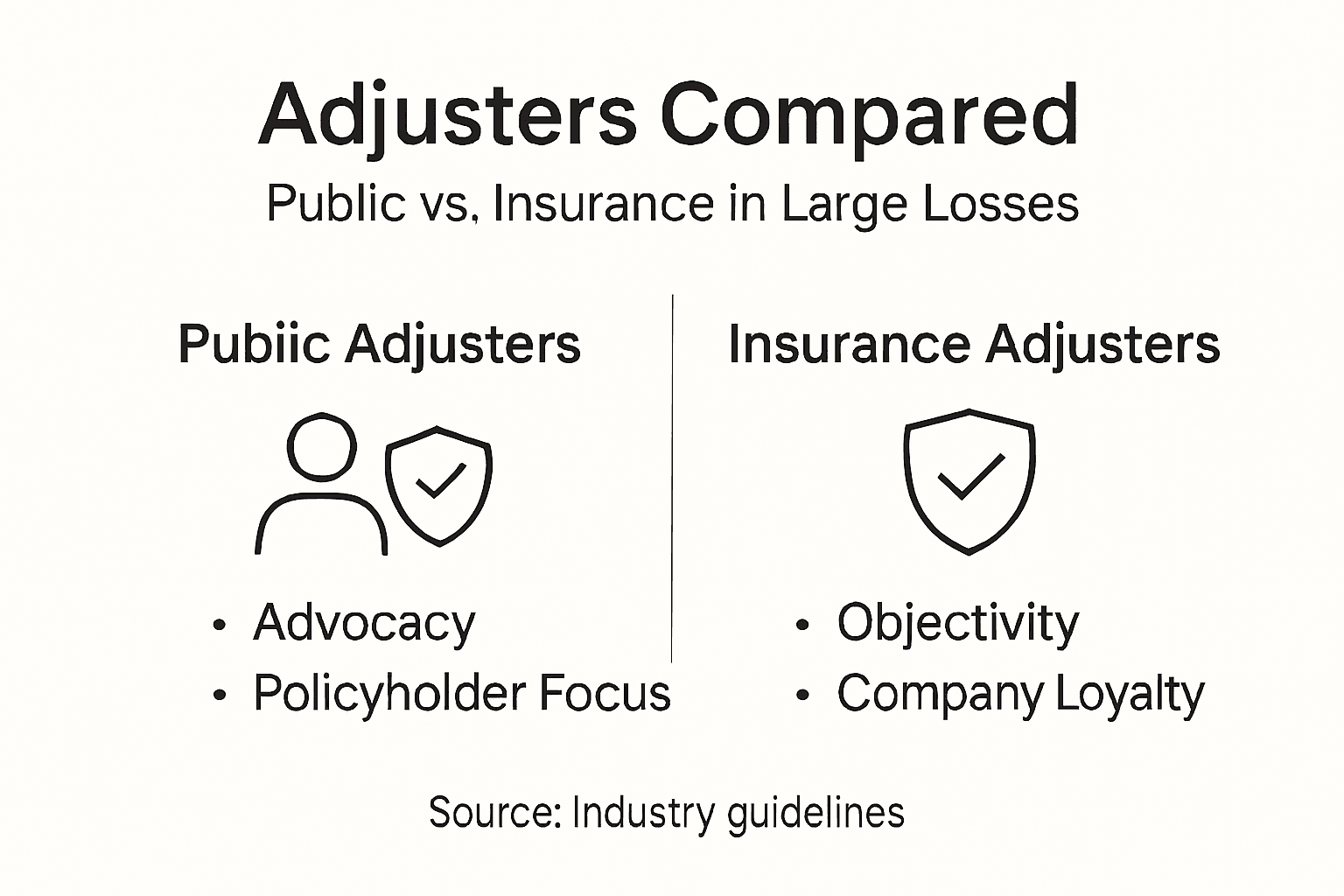
The key distinctions between public and insurance adjusters can be understood through their core responsibilities and motivations:
Insurance Company Adjusters
- Employed directly by insurance providers
- Prioritize company’s financial interests
- Aim to verify claim validity and limit potential payouts
- Conduct objective assessments based on policy terms
Public Adjusters
- Independent professionals hired by policyholders
- Exclusively represent the insured’s interests
- Focus on maximizing potential claim compensation
- Provide comprehensive claim documentation and negotiation support
Motivational Differences emerge as the most significant distinguishing factor. Insurance company adjusters are fundamentally motivated by risk management and cost containment, while public adjusters are driven by securing the most comprehensive compensation possible for their clients.
The relationship between an adjuster and their client fundamentally determines the approach to claim resolution and potential financial outcomes.
While insurance company adjusters maintain professional objectivity, public adjusters act as dedicated advocates. They invest considerable time analyzing policy details, documenting damages comprehensively, and strategically negotiating to ensure policyholders receive fair and maximum compensation for their losses.
Pro tip: Consider hiring a public adjuster for complex claims involving significant property damage or when you feel the insurance company’s initial assessment seems inadequate.
Common Pitfalls and How to Avoid Them
Large loss insurance claims are fraught with potential complications that can significantly impact claim outcomes. Common challenges in loss claim processes require strategic navigation and proactive management to ensure successful resolution.
The most prevalent pitfalls in large loss claims include:
Incomplete Documentation
- Insufficient evidence collection
- Lack of detailed damage records
- Missing critical supporting materials
Communication Breakdowns
- Poor coordination between stakeholders
- Delayed information sharing
- Miscommunication about claim specifics
Valuation Challenges
- Underestimating actual property damage
- Insufficient understanding of repair costs
- Inadequate assessment of long-term impacts
Strategic Mitigation involves implementing comprehensive approaches to address these potential issues. Proactive documentation, maintaining transparent communication channels, and engaging experienced adjusters can significantly reduce the risk of claim complications.
The following table summarizes common pitfalls in large loss claims and practical ways to address them:
| Pitfall | Impact on Claim Outcome | Smart Avoidance Strategy |
|---|---|---|
| Incomplete Documentation | Lower payout, claim delays | Maintain dated photos and written logs |
| Communication Breakdowns | Missed deadlines, dispute escalation | Centralize records, clarify contacts |
| Valuation Challenges | Underestimated compensation | Hire technical experts for assessment |
Successful large loss claims demand meticulous preparation, detailed documentation, and strategic communication across all involved parties.
Technology and professional expertise play crucial roles in overcoming these challenges. Advanced documentation tools, digital evidence collection methods, and specialized loss adjusters can help policyholders navigate complex claim landscapes more effectively. Early involvement of expert professionals can prevent potential disputes and streamline the entire claims process.
Pro tip: Create a dedicated digital folder with real-time updated documentation, including photographs, estimates, and communication logs to maintain a comprehensive claim record.
Expert Public Adjusters Ready to Maximize Your Large Loss Claim
Large loss insurance claims demand detailed documentation, expert negotiation, and strategic communication to secure the compensation you deserve. If you are facing challenges like incomplete evidence, complex damage assessments, or disputes with your insurer, professional guidance is essential. Public adjusters specialize in representing homeowners and business owners to navigate these complicated scenarios effectively, ensuring your interests are fully protected.
At Public Adjusters Atlanta, we understand the critical role adjusters play in large loss claims and provide comprehensive services including claim reviews, damage assessments, and policy evaluations tailored to your unique situation. The licensed public adjusters we work with act solely on behalf of the policyholder to maximize your settlement. Do not let communication breakdowns or valuation errors reduce the value of your claim. Get trusted support from professionals who know how to handle complex insurance processes.
Ready to take control of your insurance claim and avoid common pitfalls in large loss settlements? Visit Public Adjusters Atlanta today to schedule a free damage evaluation and start building your strongest case. Learn more about how public adjusters serve Atlanta area property owners and get the expert help you need now.
Frequently Asked Questions
What constitutes a large loss in insurance claims?
Large losses in insurance claims typically involve high-value claims that exceed standard processing protocols, often resulting from significant events such as natural disasters, major property damage, or industrial accidents.
What is the role of an adjuster in managing large loss claims?
Adjusters are responsible for thoroughly investigating claim circumstances, assessing damages, documenting evidence, negotiating settlements, and coordinating communication between insurance companies and claimants to ensure a fair resolution.
How do public adjusters differ from insurance company adjusters?
Public adjusters work exclusively for the policyholders to maximize their claims, while insurance company adjusters are employed by insurers and prioritize the financial interests of their company.
What steps are involved in the large loss claims process?
The large loss claims process includes several key stages: initial loss notification, adjuster assignment, damage investigation and documentation, damage assessment and valuation, and negotiation for settlement.
Recommended
- Role Of Adjusters In Insurance: Maximizing Your Claim
- Insurance Claim Help – The Licensed Public Adjusters Atlanta GA
- Role Of Adjusters In Settlement: Securing Fair Compensation
- Role Of Adjusters In Negotiations: Maximizing Settlements
- Moving Insurance Types Explained: Complete Breakdown – Onyx Removals