

When major property damage strikes your Georgia home or business, you face a claims process where public adjusters increase settlements by approximately 25% compared to handling claims alone. Without expert guidance, you risk leaving thousands of dollars on the table while navigating complex policy language, extensive documentation requirements, and aggressive insurer negotiation tactics. This guide provides a complete roadmap for managing large loss claims effectively, from initial damage assessment through final settlement.
Table of Contents
- Introduction To Large Loss Claims In Georgia
- Understanding The Claims Process For Large Losses
- Importance Of Thorough Damage Documentation
- Role And Benefits Of Public Adjusters In Large Claims
- Common Misconceptions In Large Loss Claims
- Legal And Policy Nuances In Large Claims
- Timelines And Procedural Expectations For Large Claims
- Claims Process Framework And Mental Models
- Conclusion And Next Steps
- How Public Adjusters In Georgia Can Support Your Large Loss Claim
- FAQ
Key takeaways
| Point | Details |
|---|---|
| Large loss claims are complex | Georgia property damage claims exceeding tens of thousands require specialized handling due to policy nuances and extensive documentation needs. |
| Documentation drives success | Thorough damage records with photos, videos, and professional assessments strengthen negotiation positions and prevent undervaluation. |
| Public adjusters maximize settlements | Licensed advocates reduce resolution time by 20% while securing significantly higher payouts through expert policy interpretation. |
| Timeline expectations matter | Resolution typically ranges from 3 to 12 months depending on claim complexity and dispute resolution needs. |
| Strategic negotiation increases payouts | Proper preparation and professional advocacy consistently improve settlement outcomes beyond initial insurer offers. |
Introduction to large loss claims in Georgia
Large loss claims involve substantial property damage requiring significant repair or replacement costs, typically exceeding tens of thousands of dollars. These claims differ from routine property damage because they involve multiple damaged systems, extended business interruptions, or complete structural failures from events like fires, severe storms, or flooding.
Georgia insurance policies contain specific provisions affecting how insurers evaluate and settle large claims. Coverage limits, deductibles, depreciation schedules, and policy exclusions create a complex landscape where minor interpretation differences translate to thousands of dollars in settlement variations. Understanding these policy-specific factors becomes essential for protecting your financial interests.
Several hurdles complicate large loss claims beyond standard property damage cases:
- Complex policy language obscuring actual coverage scope and limitations
- Extensive damage requiring multiple specialist assessments and repair estimates
- Depreciation calculations reducing replacement cost coverage significantly
- Disputed causation where insurers question whether damage falls under covered perils
- Coordination challenges when multiple properties or policy sections are involved
These factors distinguish large losses from smaller claims where straightforward damage assessment and quick settlements are possible. The stakes are higher, the process longer, and the expertise required more specialized.
Understanding the claims process for large losses
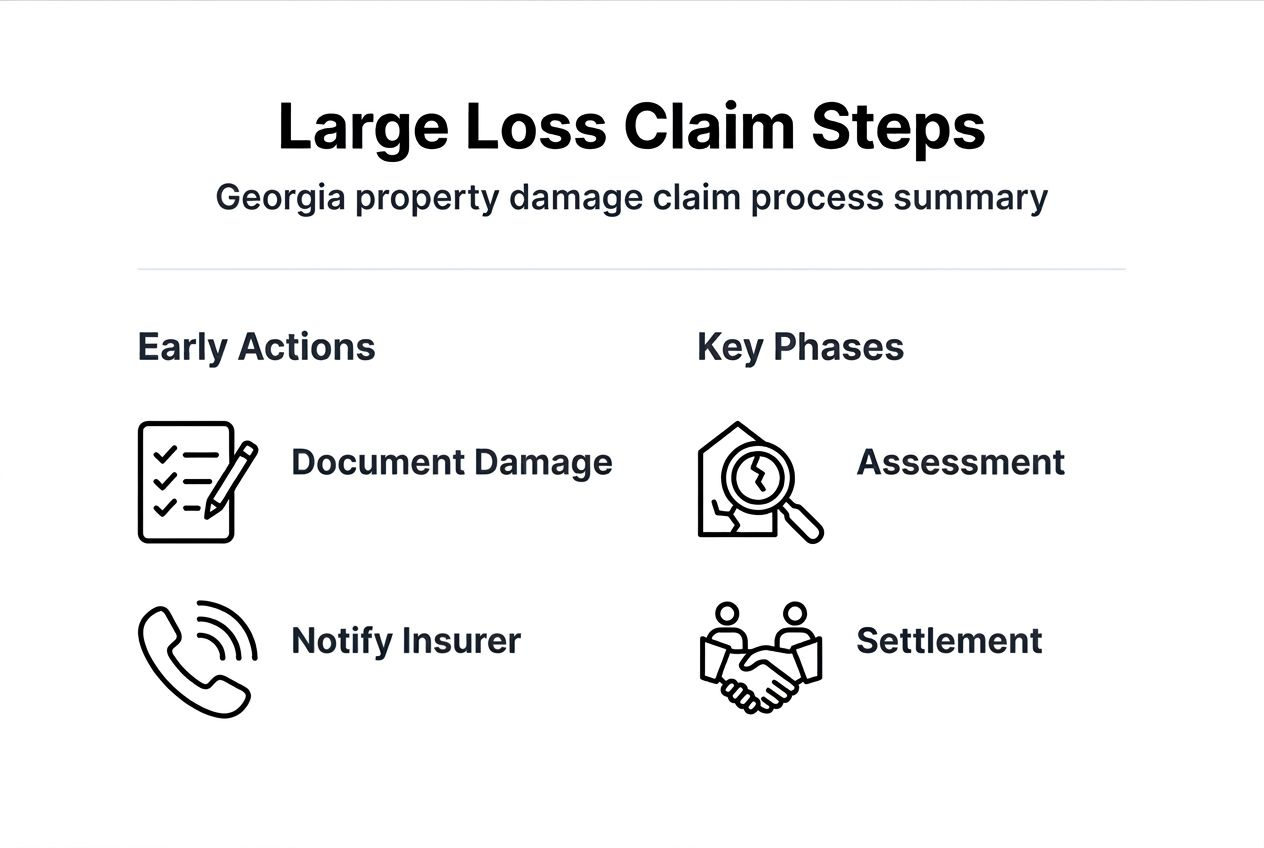
Successfully navigating a large loss claim requires understanding seven distinct stages, each with specific actions and documentation requirements.
- Immediate notification: Contact your insurer within 24 to 48 hours of discovering damage to preserve claim validity and meet policy requirements.
- Comprehensive documentation: Photograph and video all damaged areas, create detailed inventories, and secure the property to prevent further loss.
- Professional evaluation: Insurers send adjusters to assess damage scope and estimate repair costs, often using methods favoring lower valuations.
- Formal submission: Submit your claim with complete documentation, including your own damage assessments and repair estimates for comparison.
- Active negotiation: Review insurer offers carefully, challenge undervaluations with evidence, and negotiate persistently for fair compensation.
- Settlement agreement: Once terms are acceptable, finalize documentation and receive payment according to policy provisions.
- Post-settlement follow-up: Monitor actual repair costs and address any supplemental claims if hidden damage emerges during restoration.
Each stage demands attention to detail and strategic decision making. Insurers often pressure claimants to accept early settlements before full damage scope becomes apparent. Maintaining thorough records throughout protects your ability to challenge inadequate offers and supports appeals if disputes arise.
Pro Tip: Start documenting damage immediately with timestamped photos and videos from multiple angles, capturing both overview shots and close-ups of specific damage. This creates irrefutable evidence supporting your claim and prevents insurers from disputing damage extent or causation.
Engaging a public adjuster in Georgia during early stages ensures you have expert guidance through each phase, particularly during evaluation and negotiation where specialized knowledge most impacts outcomes.
Importance of thorough damage documentation
Documentation quality directly determines claim success. Incomplete or poorly organized records give insurers justification to reduce settlements or delay approvals while requesting additional information. Conversely, comprehensive evidence forces insurers to address actual damage scope rather than minimizing claims based on limited information.
Effective documentation includes multiple evidence types working together to create an unassailable damage record:
- Visual evidence: High-resolution photos and videos showing damage progression, extent, and context
- Professional assessments: Independent contractor evaluations providing repair scope and cost estimates
- Financial records: Receipts for emergency repairs, temporary housing, and lost inventory or revenue
- Policy documentation: Your insurance policy with relevant coverage sections highlighted for reference
- Communication logs: Written records of all insurer contacts, adjuster visits, and settlement discussions
This multi-layered approach prevents disputes by addressing different aspects of your claim simultaneously. Visual evidence shows what happened, professional assessments quantify repair needs, financial records document actual losses, and communication logs create accountability.
Insurers process well-documented claims faster because they reduce uncertainty and negotiation friction. When damage extent is clear and properly valued, adjusters have less room to dispute claims or justify low offers. This speeds approval timelines and increases settlement amounts by removing ambiguity insurers typically exploit.

Pro Tip: Update your damage documentation weekly during the claims process, noting any changes in property condition or new damage discoveries. Regular updates demonstrate diligence and create a timeline showing how damage evolved, which becomes critical if disputes arise over causation or extent.
Role and benefits of public adjusters in large claims
Public adjusters are licensed professionals who represent claimants exclusively, unlike insurance company adjusters who protect insurer interests. In Georgia, public adjuster licensing ensures professional standards, consumer protections, and accountability through state regulatory oversight.
Their advocacy delivers measurable benefits for large loss claims. Public adjusters increase settlements by approximately 25% and reduce resolution time by 20% compared to claimants handling claims independently. These improvements result from specialized knowledge of policy language, damage assessment expertise, and negotiation experience insurers respect.
Key advantages public adjusters provide include:
- Complete damage assessment identifying all covered losses insurers might overlook
- Expert policy interpretation uncovering coverage provisions claimants miss
- Professional documentation meeting insurer standards and legal requirements
- Aggressive negotiation challenging undervaluations with credible evidence
- Claims management handling paperwork, deadlines, and insurer communications
Many property owners hesitate to engage public adjusters due to misconceptions about costs or necessity. Georgia regulations cap public adjuster fees at reasonable percentages of settlements, ensuring their services remain cost-effective even for substantial claims. The settlement increase they secure typically exceeds their fees by significant margins.
“Working with property adjusters in Atlanta GA transformed our fire damage claim from a frustrating battle into a smooth process that recovered our full rebuild costs plus business interruption losses we didn’t know were covered.”
Understanding the role of adjusters in Georgia helps you decide when professional representation makes sense. For large, complex claims involving substantial financial stakes, public adjusters provide expertise that pays for itself through better outcomes.
Common misconceptions in large loss claims
Several persistent myths undermine claim outcomes when property owners make decisions based on incorrect assumptions rather than facts.
The most damaging misconception is that accepting the first insurer offer ensures quick settlement and avoids conflict. Negotiation typically raises settlement amounts by an average of 20% beyond initial offers. Insurers expect negotiation and structure first offers conservatively, leaving room for increases when claimants present strong evidence or professional advocacy.
Other common misunderstandings include:
- Policy complexity: Many believe insurance policies are straightforward contracts, when they actually contain technical language requiring expert interpretation to understand coverage scope fully.
- Depreciation acceptance: Property owners often accept depreciation deductions without realizing they can challenge calculations or recover depreciated amounts through proper claim handling.
- Timeline expectations: Claimants expect large loss claims to resolve as quickly as minor claims, creating frustration when realistic timelines extend months longer.
- DIY capability: The assumption that handling complex claims independently saves money ignores the substantial settlement increases professional advocacy achieves.
These misconceptions stem from unfamiliarity with insurance claim dynamics and insurer practices. Insurers benefit when claimants lack knowledge, making education your first defense against undercompensation. Persistence combined with expert guidance overcomes these obstacles and protects your financial interests.
Legal and policy nuances in large claims
Insurance policies contain technical provisions that dramatically affect claim valuations. Understanding these concepts empowers you to challenge insurer calculations and negotiate effectively.
Depreciation reduces claim payments by accounting for property age and wear. Insurers calculate depreciation using formulas that often overstate value reduction, particularly for structural components with long useful lives. Challenging these calculations with evidence of proper maintenance, quality materials, or remaining useful life can recover thousands in reduced depreciation deductions.
Replacement cost policies differ fundamentally from actual cash value policies in how they compensate losses:
| Feature | Replacement Cost | Actual Cash Value |
|---|---|---|
| Payment basis | Full cost to replace damaged property with similar quality | Replacement cost minus depreciation for age and wear |
| Initial payment | Actual cash value upfront, remainder after repairs complete | Full settlement paid immediately |
| Total compensation | Higher, covering complete replacement without depreciation penalty | Lower, reduced by depreciation calculations |
| Premium cost | Higher monthly premiums reflecting greater coverage | Lower premiums due to reduced insurer liability |
These policy differences create negotiation leverage points. If you have replacement cost coverage, insurers must justify any depreciation holdbacks and release remaining funds when repairs are completed. Understanding these mechanics prevents accepting settlements that shortchange your actual policy benefits.
Review your policy carefully before negotiating. Highlight sections supporting full compensation and use them as leverage when insurers propose reduced settlements. Policy language provides your strongest negotiation foundation when interpreted correctly.
Timelines and procedural expectations for large claims
Large loss claims typically take 3 to 12 months to resolve, with timelines varying based on damage complexity, policy disputes, and negotiation dynamics. Setting realistic expectations prevents frustration and helps you plan restoration activities appropriately.
Delays commonly exceed six months due to disputes over cause of loss, damage scope, and policy interpretation. Insurers sometimes slow processes intentionally, hoping claimants will accept lower settlements to expedite payment. Recognizing this tactic helps you maintain patience and negotiation leverage.
Common delay causes include:
- Causation disputes: Disagreements over whether damage resulted from covered perils or excluded causes
- Extent disagreements: Conflicting assessments of damage scope requiring additional inspections or specialist evaluations
- Coverage questions: Policy interpretation differences about whether specific losses fall under coverage provisions
- Documentation requests: Insurer demands for additional evidence or clarification extending review periods
Disputes significantly extend timelines beyond standard claim durations. When insurers deny claims or propose inadequate settlements, appeals and formal dispute resolution processes add months to final resolution. Early dispute mitigation through professional advocacy and thorough documentation minimizes these extensions.
“Our storm damage claim stalled for eight months while the insurer disputed wind versus flood causation. Engaging a public adjuster broke the deadlock within six weeks by presenting meteorological evidence and engineering assessments the insurer couldn’t refute.”
Pro Tip: Document all delays and communication gaps throughout your claim process. If resolution extends unreasonably, this record supports bad faith claims or regulatory complaints pressuring insurers to settle fairly.
Claims process framework and mental models
Organizing large loss claims into four distinct phases simplifies complexity and helps you track progress systematically.
- Preparation phase: Assess damage completely, gather documentation, review policy coverage, and establish your claim strategy.
- Submission phase: File formal claims with comprehensive evidence, including independent assessments and detailed loss inventories.
- Negotiation phase: Review insurer offers critically, present counter-evidence for disputed items, and negotiate persistently for fair compensation.
- Settlement phase: Finalize agreements, ensure payment terms match policy provisions, and monitor actual restoration costs for supplemental claims.
| Phase | Primary Goals | Critical Actions | Expected Outcomes |
|---|---|---|---|
| Preparation | Understand full damage scope and policy coverage | Document damage, secure property, review policy terms | Complete claim package ready for submission |
| Submission | Present strongest possible claim with thorough evidence | File formal claim, provide all supporting documentation | Insurer acknowledgment and initial evaluation |
| Negotiation | Secure maximum compensation under policy terms | Challenge undervaluations, present expert assessments | Fair settlement offer reflecting actual damages |
| Settlement | Finalize payment and begin restoration | Review settlement terms, coordinate repairs, monitor costs | Completed claim with full compensation received |
This framework provides structure for managing your claim systematically. Each phase has specific objectives and deliverables, making it easier to track where you are in the process and what comes next.
Applying this framework practically:
- Identify your current phase based on recent activities and insurer communications.
- Review the critical actions for that phase and ensure you’ve completed each one thoroughly.
- Prepare for the next phase by gathering necessary resources and expertise in advance.
- Track progress using the expected outcomes as milestones confirming phase completion.
- Adjust timeline expectations based on whether you’re moving through phases smoothly or encountering disputes requiring additional time.
Conclusion and next steps
Successfully navigating large loss claims in Georgia requires understanding the complete process, maintaining thorough documentation, and negotiating strategically for fair compensation. The seven-stage claims process provides a roadmap, while professional advocacy through public adjusters dramatically improves outcomes and reduces stress.
Before moving forward with your claim, complete this preparation checklist:
- Notify your insurer immediately and confirm receipt of your claim notification
- Document all damage thoroughly with photos, videos, and detailed written descriptions
- Review your policy carefully, highlighting relevant coverage sections and exclusions
- Gather repair estimates from licensed contractors familiar with insurance restoration work
- Consider engaging a licensed public adjuster for claims exceeding $50,000 or involving complex damage
- Organize all documentation chronologically in both digital and physical formats
- Establish a communication log tracking all insurer contacts and adjuster interactions
Professional help becomes especially valuable for high-value claims, disputed causation cases, or situations where initial insurer offers seem inadequate. Licensed public adjusters bring expertise that levels the playing field against insurer resources and experience.
Use the knowledge and tools from this guide to approach your claim confidently. Large loss claims are challenging, but systematic preparation, thorough documentation, and strategic negotiation protect your interests and maximize your recovery.
How public adjusters in Georgia can support your large loss claim
Navigating large property damage claims becomes significantly easier with expert advocacy. Licensed public adjuster services handle every aspect of your claim, from initial damage assessment through final settlement negotiation.
These professionals specialize in maximizing settlements while reducing the time and stress of managing complex insurance claims in Atlanta GA. They assess complete damage scope, prepare comprehensive documentation meeting insurer standards, and negotiate aggressively based on policy provisions insurers often overlook. Unlike insurance company adjusters who protect insurer interests, public adjusters work exclusively for you.
Choosing between a public adjuster versus attorney depends on your specific situation. Public adjusters focus on claim valuation and settlement negotiation, while attorneys become necessary if litigation arises. For most large loss claims, public adjusters provide the specialized expertise needed without legal proceedings.
FAQ
What defines a large loss claim in Georgia?
Large loss claims involve extensive property damage requiring significant repair or replacement costs, typically exceeding tens of thousands of dollars. These claims include complex damages from fires, severe storms, flooding, or multiple system failures affecting substantial portions of your property. The designation matters because it determines whether specialized claim handling and professional advocacy are necessary for protecting your financial interests.
How can public adjusters improve my settlement amount?
Public adjusters assess complete damage scope, ensure thorough documentation, and negotiate firmly with insurers using expert policy interpretation. Public adjusters increase settlements by approximately 25% and reduce resolution time by 20% compared to handling claims independently. Their expertise uncovers overlooked policy benefits and challenges undervaluations through credible evidence insurers must address.
What is the typical timeline for resolving large loss claims in Georgia?
Large loss claims typically take 3 to 12 months to resolve, depending on disputes and complexity. Resolution time varies based on damage extent, policy interpretation questions, and negotiation dynamics. Early comprehensive documentation and professional advocacy can shorten timelines by reducing disputes and streamlining insurer review processes.
What documentation is essential to support a large loss claim?
Critical documentation includes photos and videos of all damage areas taken immediately after loss, showing both overview shots and detailed close-ups. Professional damage assessments and repair estimates from licensed contractors provide credible valuation evidence. Receipts for temporary repairs, emergency services, and related expenses document your actual losses. Maintain consistent updates and organized records throughout the claim duration to support negotiations and prevent disputes.
How should I handle disputes or low settlement offers?
Review offers carefully with a public adjuster or independent expert to identify undervaluations and coverage gaps. Present comprehensive documentation, professional assessments, and policy provisions supporting higher compensation during negotiation. Negotiation raises settlement amounts by an average of 20% beyond initial offers. Consider formal appeals, mediation, or regulatory complaints if insurers refuse fair settlements despite strong evidence supporting your claim.