

Many Georgia homeowners believe their insurance will cover all storm damage without hassle. Unfortunately, insurers frequently offer initial settlements 15-25% below actual repair costs. Understanding how to properly document damage, file strategically, and negotiate effectively can increase your payout significantly. This guide walks you through every step to maximize your storm damage claim.
Table of Contents
- Types Of Storm Damage And What Insurance Covers In Georgia
- Reading And Understanding Your Storm Damage Insurance Policy
- Documenting And Assessing Storm Damage Accurately
- The Storm Damage Claim Filing And Processing Timeline In Georgia
- Common Misconceptions And Pitfalls In Storm Damage Claims
- Benefits Of Professional Representation: Hiring A Public Adjuster
- Practical Steps To Maximize Your Storm Damage Insurance Claim
- Expert Public Adjusting Services In Georgia To Maximize Your Claim
- Frequently Asked Questions About Storm Damage Insurance Claims In Georgia
Key takeaways
| Point | Details |
|---|---|
| Coverage types | Georgia policies cover wind, hail, and tornado damage but exclude floods without separate insurance. |
| Documentation impact | Thorough damage documentation increases settlements by up to 30%. |
| Professional help | Public adjusters typically boost settlements 20-30% through expert negotiations. |
| Common mistakes | Under-documenting hidden damage and missing deadlines reduce claim values substantially. |
| Timing matters | Georgia law requires prompt claim filing and insurer responses within specific timeframes. |
Types of storm damage and what insurance covers in Georgia
Georgia property owners face various storm threats annually. Your standard homeowner or business policy typically covers wind damage from hurricanes, hail impacts, and tornado destruction. These policies also address water damage from rain entering through storm-created openings like damaged roofs or broken windows.
However, flood damage requires separate insurance as it is excluded from standard policies. This distinction catches many property owners off guard after severe weather events. Standing water from overflowing rivers or heavy rainfall needs dedicated flood coverage through the National Flood Insurance Program or private insurers.
Windstorm deductibles in Georgia vary significantly. Some policies use percentage-based deductibles calculated from your dwelling coverage amount, while others apply fixed dollar amounts. A 2% windstorm deductible on a $300,000 home means you pay $6,000 before insurance coverage begins. Understanding your specific deductible structure prevents unpleasant surprises during storm damage insurance claims in Atlanta.
Common covered storm damages include:
- Roof damage from wind, hail, or falling trees
- Broken windows and compromised exterior walls
- Water damage from storm-created structural openings
- HVAC system damage from hail or wind-blown debris
- Garage door destruction from high winds
Recognizing hidden storm damages in Georgia like foundation cracks or interior moisture infiltration requires careful inspection. These concealed issues often worsen over time if left unaddressed.
Reading and understanding your storm damage insurance policy
Your policy document contains critical details affecting claim outcomes. Start by locating your declarations page, which lists coverage limits, deductibles, and specific policy terms. The dwelling coverage amount represents the maximum your insurer will pay for structural repairs.
Percentage-based windstorm deductibles calculate your out-of-pocket costs as a percentage of dwelling coverage. A $400,000 home with a 1% windstorm deductible requires you to cover the first $4,000 of repairs. Fixed deductibles apply the same dollar amount regardless of claim size, typically ranging from $500 to $2,500 in Georgia.
Coverage limits cap total payouts for different damage categories. Your policy might provide $400,000 for dwelling repairs but only $20,000 for detached structures like sheds or fences. Understanding these caps helps set realistic expectations when filing property damage claims.
Common policy exclusions beyond flood damage include:
- Gradual deterioration or maintenance issues
- Damage from pests or mold growth
- Earth movement like sinkholes or landslides
- Intentional damage or neglect
Pro Tip: Call your insurance agent before storm season to verify your exact deductible type and amount. Many policyholders discover their windstorm deductible differs significantly from their standard deductible only after filing claims. This proactive step allows you to budget appropriately and avoid confusion during stressful claim situations. Review your storm damage insurance claims basics annually to stay informed about coverage changes.
Documenting and assessing storm damage accurately
Comprehensive documentation separates successful claims from disappointing settlements. Up to 40% of storm damage claims lack documentation of hidden damages, reducing total claim value significantly. Begin your assessment immediately after ensuring personal safety, capturing evidence before temporary repairs become necessary.
Take clear photographs and videos from multiple angles. Document every damaged area including roofs, siding, windows, gutters, and landscaping. Interior shots should capture water stains, ceiling damage, and any structural concerns. Videos provide context that static photos cannot convey, showing the extent and relationship between different damage areas.
Hidden damages often include:
- Attic moisture and insulation compromise
- Foundation cracks from settling or water pressure
- HVAC ductwork separation or damage
- Electrical system water exposure
- Structural framing stress or displacement
Professional inspections uncover damage invisible to untrained eyes. Roof specialists identify subtle granule loss on shingles, while structural engineers assess foundation integrity. These expert evaluations strengthen your claim documentation and prevent future problems from undetected damage.
Create a detailed inventory spreadsheet listing each damaged item or area. Include replacement costs, age, and condition before the storm. Organize photos chronologically with timestamps and location descriptions. This systematic approach demonstrates thoroughness to insurance adjusters.
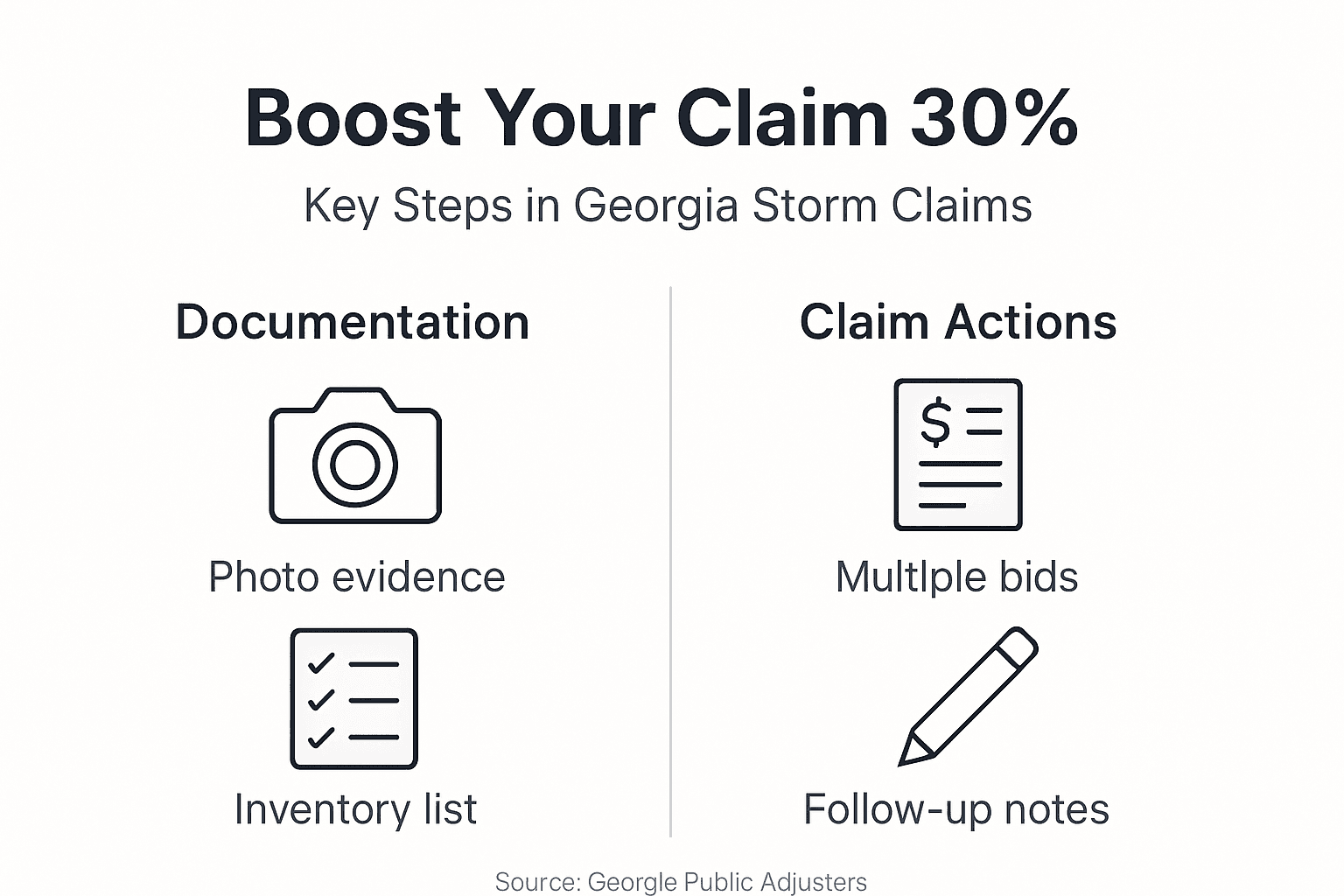
Comprehensive documentation can boost claim settlements by up to 30% compared to poorly documented claims. Insurers respect detailed evidence and find fewer reasons to dispute your assessment. Your detailed storm damage documentation becomes your strongest negotiation tool.

Pro Tip: Use a cloud storage service to back up all documentation immediately. Phone damage or loss during chaotic post-storm periods could erase irreplaceable evidence. Automatic cloud backup ensures your documentation remains accessible throughout the claims process, even if devices fail. Understanding the importance of documenting hidden storm damage protects your financial interests long term.
The storm damage claim filing and processing timeline in Georgia
Georgia insurance regulations establish specific timeframes for claim handling. You must notify your insurer promptly after discovering damage, typically within days as specified in your policy. Most policies require notification within 60 days, though immediate reporting accelerates processing and demonstrates diligence.
Insurers must acknowledge your claim within 15 days of notification under Georgia law. They schedule adjuster inspections usually within one to two weeks, depending on storm severity and claim volume. Major weather events create backlogs, so early filing positions you ahead of other claimants.
The typical storm damage claim process follows these steps:
- File your claim immediately with complete contact information and initial damage summary.
- Schedule and attend the adjuster inspection, providing your documentation and answering questions.
- Document all communications including adjuster names, visit dates, and conversation summaries.
- Review the settlement offer carefully, comparing it against your damage assessment and repair estimates.
- Negotiate if the offer seems insufficient, providing additional evidence or expert opinions.
- Appeal formally if negotiations fail, following your policy’s dispute resolution procedures.
Adjusters typically complete inspections within two to four weeks after scheduling. They assess visible damage, take measurements, and estimate repair costs using industry pricing databases. Their initial estimates often miss hidden damages or undervalue repair complexity.
Georgia law requires insurers to pay or deny claims within 60 days of receiving all required documentation. Extensions apply when investigations require more time, but insurers must communicate delays and reasons. Missing these deadlines gives you leverage in negotiations or complaints to the Georgia Insurance Commissioner.
Track every interaction meticulously. Save emails, note phone conversation details with dates and times, and request written confirmation of verbal agreements. This documentation protects you if disputes arise and demonstrates your organized approach to the claim.
Common misconceptions and pitfalls in storm damage claims
Many property owners hold false beliefs that undermine their claims. Assuming insurers automatically pay full replacement costs without negotiation leaves money on the table. DIY claim filing without professional help often results in missed damages and lower compensation by around 25%.
The table below contrasts different claim filing approaches:
| Approach | Average Settlement | Documentation Accuracy | Stress Level |
|---|---|---|---|
| DIY Filing | 70-75% of damages | Moderate (often misses hidden issues) | High |
| Public Adjuster | 95-100% of damages | Comprehensive (expert identification) | Low |
Widespread misconceptions include believing flood damage falls under standard policies or thinking all storm damage receives immediate full payment. These misunderstandings lead to claim denials or disappointment when settlement checks arrive.
Common pitfalls that reduce settlements:
- Inadequate photo documentation of all damaged areas
- Missing policy-specified notification deadlines
- Misunderstanding deductible application and amounts
- Accepting initial lowball settlement offers without negotiation
- Failing to document hidden or secondary damages
- Making permanent repairs before adjuster inspection
- Not obtaining independent repair estimates
Insurers count on claimants accepting initial offers without question. Their first settlement proposal frequently undervalues damages by 15-30%, leaving room for negotiation. Pushing back with solid evidence and contractor estimates often yields substantially higher payments.
Understanding storm damage insurance misconceptions protects you from these costly errors. Knowledge empowers effective advocacy for fair compensation. The risks of DIY insurance claims become clear when comparing outcomes between self-filed claims and professionally managed ones.
Benefits of professional representation: hiring a public adjuster
Licensed public adjusters work exclusively for policyholders, not insurance companies. They assess damage comprehensively, prepare detailed documentation, and negotiate directly with insurers on your behalf. This specialized expertise levels the playing field against insurance company adjusters protecting their employer’s interests.
Statistics show public adjusters increase settlement amounts by 20-30% on average compared to self-filed claims. Their experience identifying hidden damages and understanding policy language maximizes your compensation. They know industry pricing standards and recognize when insurer estimates undervalue repairs.
Key benefits of hiring public adjusters in Georgia include:
- Expert damage assessment uncovering issues you might miss
- Professional documentation meeting insurer requirements
- Reduced paperwork burden and administrative stress
- Stronger negotiating position with insurance companies
- Understanding of policy language and coverage nuances
- Ability to challenge unfair claim denials effectively
Public adjusters typically charge contingency fees ranging from 10-20% of the final settlement. You pay nothing upfront, and their compensation comes from the increased settlement they secure. This arrangement aligns their interests with yours, motivating maximum effort.
The role of public adjusters extends beyond paperwork. They handle all insurer communications, attend inspections, obtain repair bids, and advocate throughout the process. This comprehensive service provides peace of mind during stressful recovery periods.
Pro Tip: Consider hiring a public adjuster especially when damages exceed $25,000 or involve complex structural issues. Their expertise becomes particularly valuable for large claims where even small percentage improvements mean thousands of dollars. Early engagement allows them to document damage before deterioration or temporary repairs complicate assessment. Public adjuster benefits for homeowners become most apparent in challenging claim situations.
Practical steps to maximize your storm damage insurance claim
Following a systematic approach ensures you capture maximum compensation. These actionable steps build on everything covered in this guide, providing a clear roadmap from damage discovery through final settlement.
Implement these steps for optimal results:
- Review your policy carefully, noting coverage limits, deductibles, and notification requirements before filing.
- Inspect your property thoroughly and document all visible and hidden damage with photos, videos, and detailed notes.
- File your claim promptly with complete initial evidence, meeting all policy deadlines and requirements.
- Track all communications meticulously, saving emails and documenting phone conversations with dates and names.
- Consider hiring a public adjuster when damages are extensive or complex, especially for claims exceeding $25,000.
- Negotiate settlement offers proactively using independent repair estimates and documentation of all damages.
Consistency matters throughout the process. Regular follow-up with your insurer demonstrates engagement and prevents your claim from languishing. Request status updates every few days and document responses.
Obtain multiple contractor estimates for repairs. Three independent bids provide strong evidence of actual repair costs and counter lowball insurer estimates. Choose licensed, insured contractors with storm damage experience and positive references.
Don’t rush settlement acceptance. Review offers carefully against your documentation and contractor estimates. If the amount seems insufficient, present additional evidence and request reconsideration. Most insurers negotiate rather than face formal disputes.
Pro Tip: Keep a dedicated claim journal recording every interaction, document submission, and milestone. Include dates, contact names, conversation summaries, and follow-up items. This organized approach prevents missed deadlines and provides clear records if disputes arise. Your storm damage claim checklist becomes your strategic roadmap through the entire process.
Expert public adjusting services in Georgia to maximize your claim
Navigating storm damage claims requires expertise most property owners lack. Professional public adjusters serving Atlanta, Marietta, and surrounding Georgia communities bring specialized knowledge to your situation. They uncover hidden damages insurance company adjusters frequently miss, handle complex paperwork efficiently, and negotiate aggressively for maximum settlements.
The licensed public adjuster teams we work with understand Georgia insurance regulations and local storm damage patterns. We provide free damage evaluations to assess your claim potential and explain how professional representation increases your compensation. From initial documentation through final settlement, we manage every aspect of your claim process.
Adjusting firms in Atlanta and public adjusters in Marietta GA have helped thousands of property owners secure fair compensation after storms. Our expertise in insurance claim negotiation basics ensures you receive every dollar your policy provides. Contact us today for a complimentary claim assessment.
Frequently asked questions about storm damage insurance claims in Georgia
How quickly must I file a storm damage claim in Georgia?
Most policies require notification within 60 days of discovering damage, though immediate filing is strongly recommended. Prompt reporting prevents disputes about damage timing and positions you ahead of other claimants during major storm events when insurers face high claim volumes.
What types of hidden storm damage should I look for?
Common hidden damages include attic moisture infiltration, foundation cracks from water pressure, HVAC system impacts, electrical exposure to water, and structural framing stress. Professional inspections by roofing specialists and structural engineers often uncover these concealed issues that worsen over time if unaddressed.
How do public adjusters get paid for their services?
Public adjusters typically charge contingency fees of 10-20% of your final settlement amount. You pay nothing upfront, and their fee comes only from the increased compensation they secure. This arrangement aligns their interests with maximizing your payout, as they earn more when you receive more.
Can I dispute my insurer’s settlement offer?
Yes, you can and should negotiate if the offer seems insufficient. Present additional documentation, independent contractor estimates, and evidence of damages the adjuster missed. Most insurers negotiate rather than face formal appeals, and persistent advocacy with solid evidence frequently yields 20-30% higher settlements.
Does my Georgia homeowner policy cover flood damage from storms?
No, standard homeowner and business policies exclude flood damage, which requires separate flood insurance through NFIP or private insurers. This distinction catches many property owners unprepared after severe weather, making it critical to review your coverage before storm season and obtain flood insurance if you live in vulnerable areas.